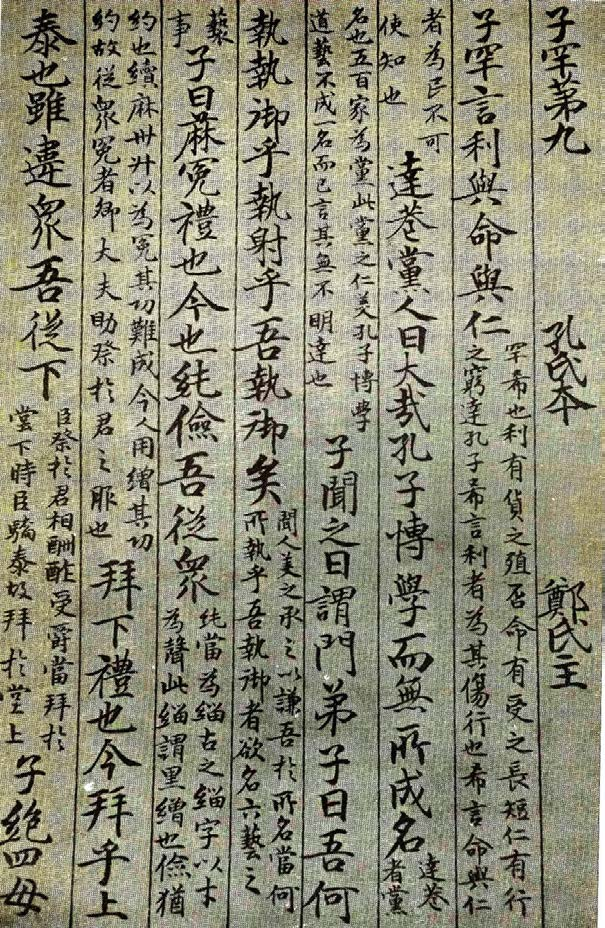
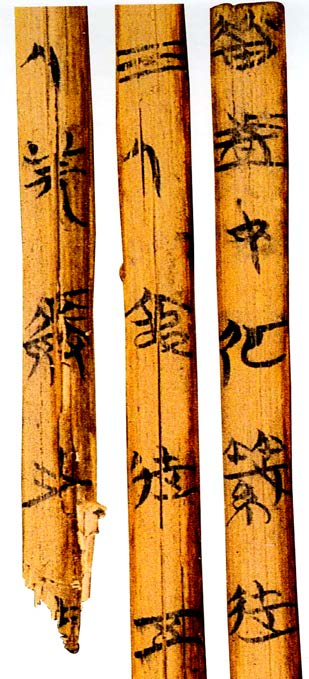
The title page illustration reproduces a leaf from a medieval hand copy of the Analects, dated 890 CE, recovered from an archaeological dig at Dunhuang, in the Western desert regions of China. The manuscript has been determined to be a school boy’s hand copy, complete with errors, and it reproduces not only the text (which appears in large characters), but also an early commentary (small, double-column characters). (The quality of schoolboy “handwriting” – actually brush and ink work – should probably make us all feel inadequate.)
Thousands of scholarly commentaries in Chinese have been written in the 2500 years of the Analects’ existence. Because so much important contextual information about the characters and special terms in the text does not appear within the Analects, having originally been provided by teachers, we would find the text almost impossible to read with understanding were it not that early commentators preserved much of this information in their interlinear notes. Recovery of this particular copy of the text was unusually valuable, because the second century CE commentary it includes is a famous one by a great early scholar that has otherwise been largely lost. Unfortunately, the recovered text was only of a portion of the Analects, so we do not now possess the entire commentary, but we are fortunate to have found even a part.
The page illustrated is the opening portion of Book IX.
SourcePDF p. 5
Introduction
The Analects of Confucius is an anthology of brief passages that present the words of Confucius and his disciples, describe Confucius as a man, and recount some of the events of his life. The book may have begun as a collection by Confucius’s immediate disciples soon after their Master’s death in 479 BCE. In traditional China, it was believed that its contents were quickly assembled at that time, and that it was an accurate record; the English title, which means “brief sayings of Confucius,” reflects this idea of the text. (The Chinese title, Lunyu 論語, means “collated conversations.”) Modern scholars generally see the text as having been brought together over the course of two to three centuries, and believe little if any of it can be viewed as a reliable record of Confucius’s own words, or even of his individual views. Rather, much like the biblical Gospels, to which the text bears some resemblance, the Analects offers an evolving record of the image of Confucius and his ideas through from the changing standpoints of various branches of the school of thought he founded.
This online translation is posted to make it easier to locate an English rendering of this important text with some basic commentary. It has been prepared for use in undergraduate teaching and is not meant to replace published scholarly editions. The interpretations reflected are my own, and in some cases do not represent consensus readings (if such exist – there are, and always have been, competing interpretations of many of the most engaging passages in the text, starting from passage 1.1).
In this very brief introduction to the text, I will summarize a few features of Confucius’s life and social environment, review some basic ways in which the component parts of the Analects are dated by analysts, on a very general level, and note some particular issues concerning key terms and translation, and of personal names.
Confucius
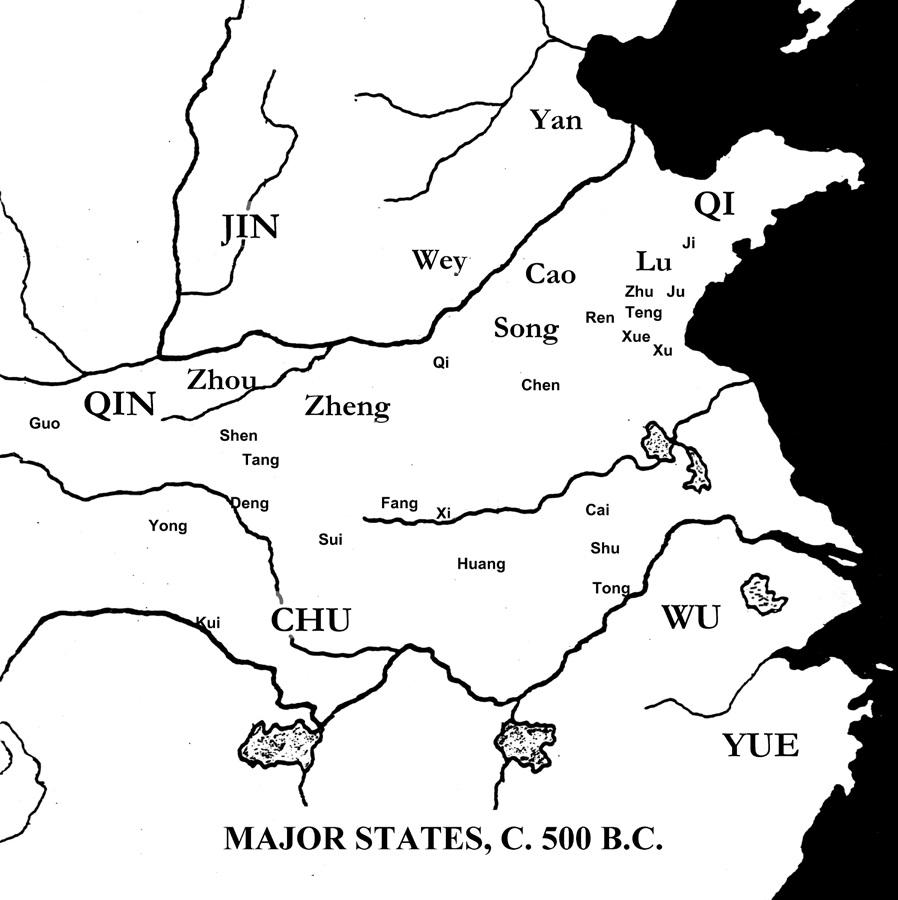
“Confucius” is the name by which English speakers know Kong Qiu 孔丘, born near a small ducal state on the Shandong Peninsula in 551 BCE. Centuries earlier, a strong royal state, known as the Zhou (founded in 1045 BCE), had sent members of its high aristocracy to rule regions of its empire as hereditary lords, subjects of the Zhou king, but, so long SourcePDF p. 6 as they remained loyal, masters of their local domains. In 771 BCE, raids by non-Zhou nomadic peoples led to the death of the Zhou king and the removal of the Zhou capital; from that time on, the Zhou kings had become weak, and the feudal lords had become de facto sovereigns over essentially independent states and statelets. Three themes of Confucius’s day were incessant warfare, which had been pervasive among the feudal lords since the devolution of power into their hands, the further devolution of power from the Zhou-appointed feudal houses into the hands of subordinate families that managed to accumulate power locally, and the rising fluidity of social mobility which this type of open competition for power encouraged, as intelligence and warrior skills in their assistants proved more valuable to competing power-holders than did hereditary pedigree.
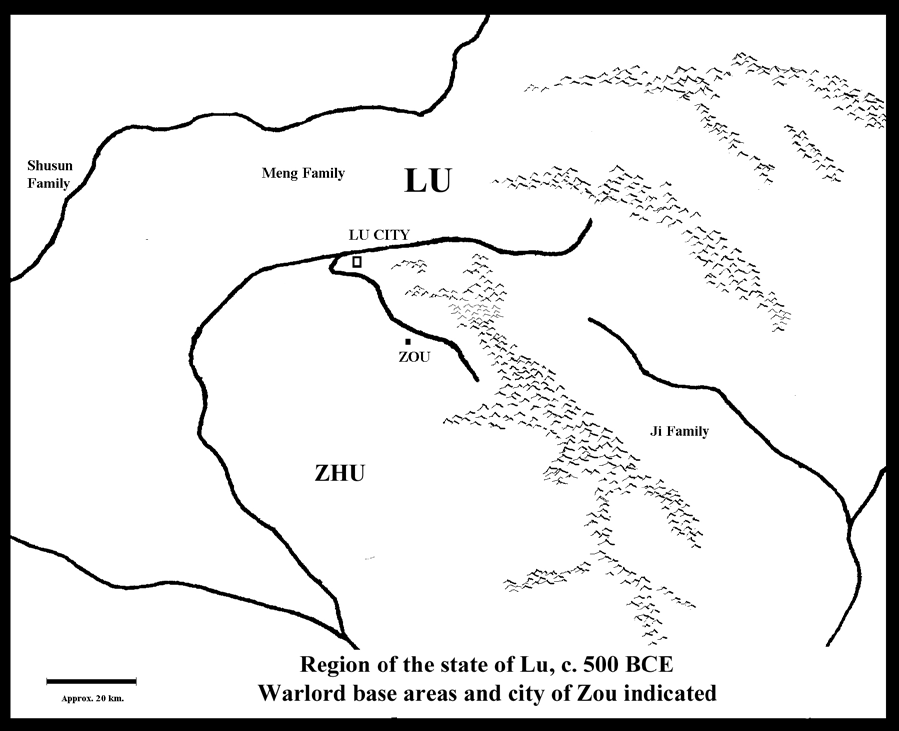
Confucius’s father was a member of the low aristocracy of the medium sized state of Lu 魯. According to our best sources, he was an important aide to a major aristocratic, or “grandee” family. During his prime, this family had served the greatest power holders in Lu by controlling a domain assigned to them on Lu’s southern border, near a small, non-Zhou cultural area called Zou 鄹. Shortly before Confucius’s birth, the family’s domain was relocated to the north, but Confucius’s father, having by his primary wife and his concubines produced no healthy sons to carry on his line, and being now an older man, chose at this time to take as a concubine a woman of Zou. She soon gave birth to Confucius. Three years later, Confucius’s father died, and Confucius apparently grew up with his mother’s family in the border region between Lu and Zou. Reaching adulthood, he traveled to the feudal center of Lu to seek social position, based on his father’s standing and connections.
The state of Lu took pride in the fact that the lineage of its rightful lords, the dukes of Lu, had begun with a famous brother of the Zhou dynastic founder, a man known as the Duke of Zhou. Treasuring Zhou traditions with which he was associated, after the decline of the Zhou royal house the state of Lu had become known as the purest repository of Zhou aristocratic culture. But during the sixth century, these traditions were undermined, as powerful warlord families gained increasing control of government and resources in Lu, gradually marginalizing the legitimate ducal house, and distorting the norms of government form and ceremonial ritual that had made Lu distinct.
SourcePDF p. 7 When Confucius sought his fortune in Lu, he probably appeared there as a semioutsider, the son of a “mixed” union between a man of Lu, who had long resided in Zou, and a woman of that non-Zhou place (see passage 3.15). But Confucius made his reputation as a strong advocate of a puristic revival of Zhou traditions in court conduct, religious ceremony, and every aspect of ordinary life. He became expert in these traditions, and it was on the basis of this knowledge and the persuasiveness of his claim that the way to bring order back to “the world” was to recreate early Zhou society through its ritual forms, or “li,” that Confucius became known. The details of what Confucius saw as legitimate Zhou culture and why he thought its patterns were tools for building a new utopia are the principal subjects of the Analects.
His mastery of Zhou cultural forms allowed Confucius to become a teacher of young aristocrats seeking polish, and through their connections, he was able to gain some stature in Lu. Ultimately, he and some of his followers attempted to implement a grand restorationist plan in Lu that would have shifted power back to the ducal house. Shortly after 500 BCE, when Confucius was about fifty, the plan failed, and Confucius was forced to leave his home state. For about fifteen years, he traveled with a retinue of disciples from state to state in eastern China, looking for a ruler who would employ him and adopt the policies he advocated. The Analects pictures some key moments in these travels, which ultimately proved fruitless. A few years before his death, one of Confucius’s senior disciples, a man named Ran Qiu, arranged to have Confucius welcomed back to Lu, where he lived out his days as a teacher of young men, training them in the literary, ritual, and musical arts that he saw as central to the culture of the Zhou.
The Structure and Date of the Analects
During the Classical era, texts were generally recorded by brush and ink, writing on thin strips of bamboo. These strips allowed for about two dozen Chinese characters each. Holes were drilled in each strip and the strips that belonged to a single written work were bound together in a bundle by a string. The Analects, which is composed of about five hundred independent passages, is divided into twenty “books.” Some of these books seem to have originated as strips authored, over a period of years, by a single group, and separated into bundles according to dominant themes. Others of the books seem to have originated independently, and been brought together with the larger number of books at a later SourcePDF p. 8 date. Within each book, the order of passages appears to have been disrupted over time, to greater or lesser degree, either by disarrangements that occurred after the string of a bundle broke, or because part of the composition process involved conscious rearrangement and insertion of later passages into existing bundles / books, in order to adjust the way the message of the overall text was conveyed.
Through this process, the Analects has come to appear quite random on first reading, and no depth of analysis has yet removed that sense of randomness from large portions of the text. While this is not ideal for readers who wish to understand the message of the Analects, it has been very good news for academic textual analysts, for whom the long process of trying to untangle the text and understand how it came to be shaped as it is has provided gainful employment and opportunities for tenure. * Although there is consensus about a few points, such as the fact that several of the books, such as Books XVI and XX, are very late additions, there is more disagreement than agreement about specific issues of dating and origin of the Analects’ various components. The translation that follows here operates on the following model.
Books III through VII are seen as a core text from a single, relatively early origin, with the books, in their original form (now much altered) sorted by topic in roughly this way:
Book III – General issues of ritual (li)
Book IV – General issues of character
Book V – Comments about disciples and historical figures
Book VI – Comments about disciples and historical figures
Book VII – Descriptions of Confucius
Among all the books, the most consistent in structure and apparently least altered in form is Book IV. Examination of that book does seem to yield some pretty clear principles about what the original editorial goals were, and what regular processes of alteration later occurred.
SourcePDF p. 9 Traditionally, it has been widely noted that Books I-X seem to bear some similar features of length, structure, and vocabulary, and it has become common to speak of those books as the “upper text” and Books XI-XX as the “lower text.” Rounding out the “upper text”:
Book I – Designed as an overview introduction for disciple-readers
Book II – General issues of governance
Book VIII – Miscellaneous, embedding a “core” of quotes from a disciple, Master Zeng, a diverse set of passages with some indications of common origins with Book XVII, and an outer text “shell” of historical commentary*
Book IX – Perhaps a variant version of Book VII, from a different school branch
Book X – A portrait of ritualized perfection, cast as a description of Confucius
In some of these cases (II and IX), the core theme seems to be present in a relatively small number of passages, and the books seem particularly heterogeneous.
The “lower text” is even less coherent. There seems to be some resemblance of structure and tone among Books XI-XV; in some cases, a thematic aspect seems visible, in others not.
Book XI – Comments on disciples
Book XII – General issues of governance
Book XIII – General issues of governance
Book XIV – Includes themes of reclusion
Book XV – A broad collection
It is reasonable to suggest that at their core, these five chapters originated as sorted collections made by a single branch of the school, different from the branch that may have collected Books III-VII, with the collection deriving from a somewhat later date.
The remaining five books have been regarded for several centuries as later and less authoritative than the others. For some of these, the later date seems certain:
Book XVI – Written in a very different style and dominated by numbered lists
Book XVII – Many passages “re-imagining” political issues of Confucius’s time
Book XVIII – Focusing on reclusion and responsive to “Daoist” ideas
Book XX – A small appendix of miscellaneous items
SourcePDF p. 10 One book among the final five appears different from the rest:
Book XIX – Recording the sayings of disciples after Confucius’s death
This book may well be much earlier than the others in the “lower text” – it was likely at one time the final book, and the bulk of it may actually have been composed in association with Books III-VII, viewed as the oldest portion of the book.
All of the books bear the traces of rearrangements and later insertions, to a degree that makes it difficult to see any common thematic threads at all. If a full account of these alterations in the text could be made, it would likely provide a clear and valuable reflection of the way that the Confucian school and its various branches developed over the first two or three centuries of the school’s existence.
Recent finds of early manuscripts dating from c. 300 BCE have thrown additional light on these processes of text development. For a fuller discussion, see Appendix 3.
Key Terms and Translation Issues
The philosophy conveyed through the Analects is basically an ethical perspective, and the text has always been understood as structured on a group of key ethical terms. These (along with some terms key to other early streams of Chinese thought) are discussed in more detail in the Glossary (Appendix 2). Notes in the text also touch on all these issues, but a brief overview here may be useful.
There is a group of key terms whose meaning seems to be so flexible, subtle, and disputed that it seems best to leave them untranslated, simply using transcription for them. These include:
Ren 仁 – a comprehensive ethical virtue: benevolence, humaneness, goodness; the term is so problematic that many Analects passages show disciples trying to pin Confucius down on its meaning (he escapes being pinned).
Junzi 君子 – often used to denote an ideally ethical and capable person; sometimes simply meaning a power holder, which is its original sense.
Dao 道 – a teaching or skill formula that is a key to some arena of action: an art, self-perfection, world transformation.
Li 禮 – the ritual institutions of the Zhou, of which Confucius was master; the range of behavior subject to the broad category denoted by this term ranges from political protocol to court ceremony, religious rite to village festival, daily etiquette to disciplines of personal conduct when alone.
SourcePDF p. 11 Tian – carrying the basic meaning of “sky,” Tian becomes a concept of supreme deity, often translated as “Heaven,” sometimes possessing clear anthropomorphic features, sometimes appearing more a natural force.
In addition to these items, other complex key terms are rendered by very vague English words, the meaning of which can only emerge as contextual usage is noted.
Virtue (de 德) – a very complex concept, initially related to the notion of charisma derived from power and gift-giving, developing into an ethical term denoting self-possession and orientation towards moral action.
Pattern (wen 文) – denoting a relation to features of civilization that are distinctive to Zhou culture, or to traditions ancestral to the Zhou; wen can refer to decoration, written texts, and personal conduct, but most importantly, it points to the behavioral matrix underlying Zhou li.
Finally, a set of important terms can be translated with some accuracy into English, but only with the understanding that the conceptual range of the Chinese term may not match English perfectly; in some cases, alternate English translations are used.
Right / Righteousness (yi 義) – often a complement to ren, denoting morally correct action choices, or the moral vision that allows one to make them.
Loyalty (zhong 忠) – denoting not only loyalty to one’s superiors or peers, or to individuals, but also to office; an alignment of self with the interests of others, or of the social group as a whole.
Trustworthiness / Faithfulness (xin 信) – derived from the concept of promise keeping, meaning reliability for others, but also unwavering devotion to principle.
Respectfulness / Attentiveness (jing 敬) – derived from the notion of alertness, and fusing the attentiveness to task characteristic of a subordinate and the respect for superiors that such attentiveness reflects.
Filiality (xiao 孝) – a traditional cultural imperative, obedience to parents, raised to a subtle level of fundamental self-discipline and character building.
Valor (yong 勇) – in a feudal era marked by incessant warfare, bold warriors and adventurers were common; for Confucians, valor concerns risk taking on behalf of ethical principle.
Personal Names
Although this is not clear on initial reading, the ideas of the Analects are importantly influenced by the literary character of the text, and the fact that it is presented chiefly as conversational interplay among a relatively limited cast of characters: Confucius (“the Master”), his disciples, and a group of power holders with whom Confucius interacts. The Analects was almost certainly used as a teaching text for later generations of disciples, who were taught not only the text but much detail about the contexts and characters SourcePDF p. 12 now lost to us, and it is certain that the original audience of the text developed a grasp of the rich nuances conveyed by the way statements in the text are distributed among its various speakers. Most importantly, the disciples in the Analects provided a range of positive and negative models readers could emulate as they attempted to find their way into Confucian teachings, and develop into the true inheritors of the tao of discipleship.
Unfortunately for readers of the text in translation, the characters in the Analects are each referred to by a variety of names, reflecting the customs of the times. It was the general rule that members of the aristocracy, at any level, possessed at least three types of names. They could possess many more. The three basic names are:
1. Surname (family name – family names precede other names in Chinese)
2. Personal name (given at birth, used by intimates – like our first names)
3. Style, or polite name (given at puberty, used publicly and in formal settings)
When it comes to the disciples, the narrative voice of the text usually refers to them by their polite style name, but Confucius is generally pictured calling them by their personal names (as a teacher, he was a surrogate parent). For example, in passage 11.15 (Book XI, passage 15) we read:
The Master said, “What is Yóu’s zither doing at my gate?” The disciples showed Zilu no respect.
Yóu and Zilu are the same person. He is the disciple Zhong Yóu (surname: Zhong, personal name: Yóu). Confucius calls him by his personal name, but the narrative voice, being a later disciple writing about a revered elder of the past, uses the polite Zilu. (Zilu is, in addition, referred to by what appears to be a “generational name”; Ji Yóu, the “Ji” indicating that in his family, he was the fourth eldest male of his generation.)
Finally, some disciples whose later followers likely had a clear impact on the text are referred to as “masters” in their own right; the most prominent example is “Master Zeng,” who is Zeng Shen, among the youngest of the major disciples. In the case of Zeng Shen, the influence of his own branch of the Confucian school is particularly visible; a portion of Book VIII is devoted to descriptions of his dying words, words likely uttered over forty years after the death of Confucius. The reference to any disciple as “Master” indicates that they had some later influence, but does not indicate that they were, in Confucius’s day, influential among Confucius’s own disciples. Indeed, a number of the greatest disciples died before Confucius, and thus could never have earned the title of “Master” in their own right. SourcePDF p. 13
In the notes to the text, I have tried to provide information and reminders necessary to keep track of the various disciples, so that it is possible for their characters and the individual ways their roles shape subtle meaning to emerge. But this is hard to grasp on initial reading, no matter how much help is provided. For the sake of directness, I will close this Introduction with a list of some of the major disciples, and, where it may be known, the dates that have been reconstructed for them. This list by no means exhausts the roster of disciples who appear in the Analects, or even the roster of interesting ones, but these are the ones who appear most frequently. Their names are given as surname + personal name, with style and variant names in parentheses. Fuller descriptions of the major disciples appear in Appendix 1.
Zhong Yóu 仲由 (Zilu 子路, Ji Yóu季由, Ji Lu 季路), c. 542-480
Ran Qiu 冉求 (Yŏu 有), c. 522-462
Yan Yuan 顏淵 (Hui 回), c. 521-481
Zai Wo 宰我 (Yu 予), c. 520-481
Duanmu Si 端木賜 (Zigong 子貢), c. 520-450
You Ruo 有若 (Master You), c. 518-457
Bu Shang 卜商 (Zixia 子夏), c.507-420
Yan Yan 言偃 (Ziyou 子游), c. 506-445
Zeng Shen 曾參 (Master Zeng), c. 505-436
Duansun Shi 端孫師 (Zizhang 子張), c. 503-450
Ran Yong 冉雍 (Zhonggong 仲弓), n.d.
Yuan Xian 原憲 (Si 思), n.d.
Note to Version 2.2 (2015)
The translation text in Version 2.2 includes corrections and changes, mostly minor, to Versions 2.0 (2010) and 2.1 (2012). The notes have been more extensively revised and maps on pp. x-xi have been added.
Maps
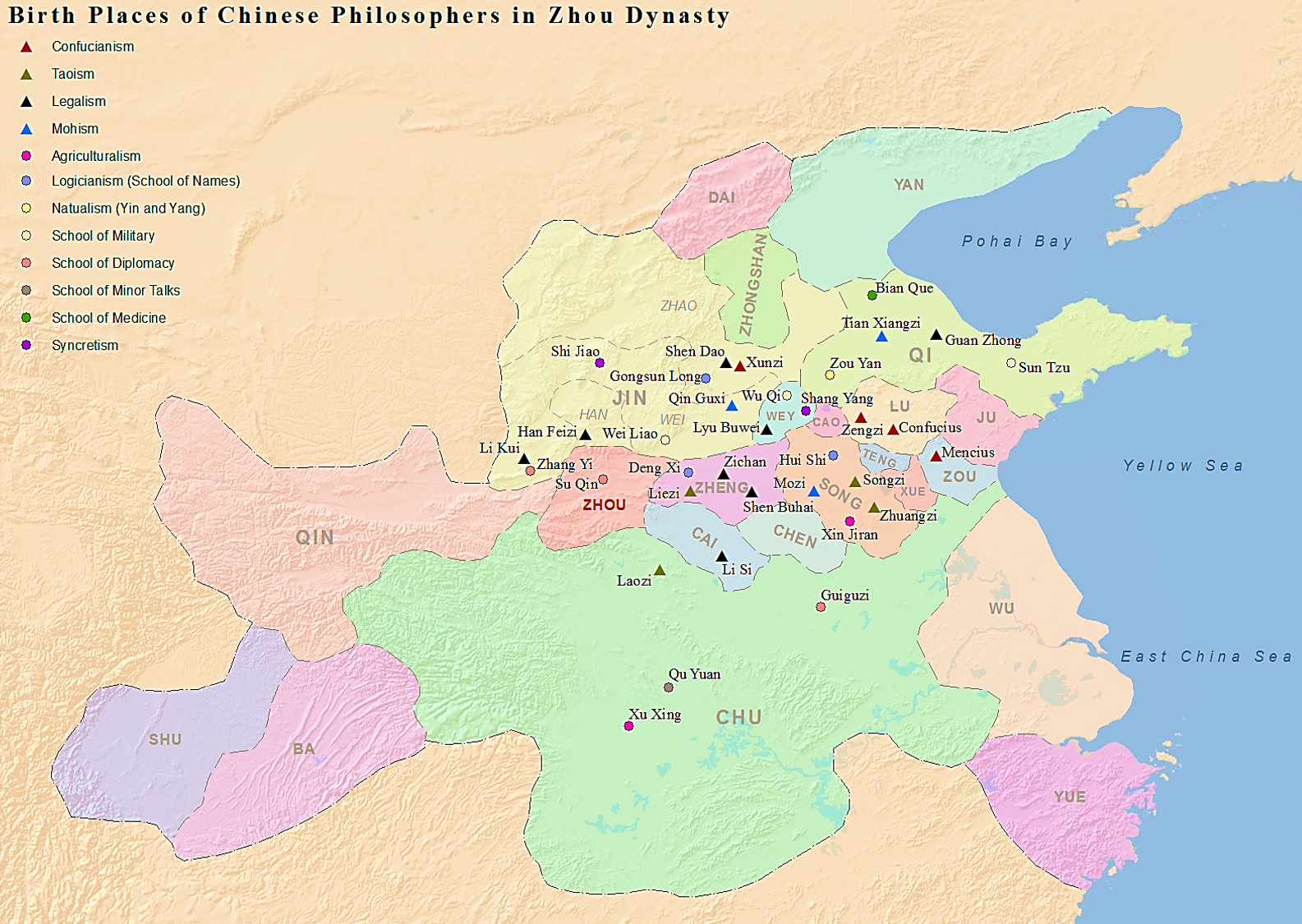
SourcePDF p. 14China in the time of ConfuciusSourcePDF p. 15The state of Lu and neighboring regionsBirth places of notable Chinese philosophers of the Hundred Schools of Thoughts in the Zhou dynasty (SY, 2018)
Book
I
SourcePDF p. 16
1.1
The Master said: To study and at due times practice what one has studied, is this not a pleasure? When friends come from distant places, is this not joy? To remain unsoured when his talents are unrecognized, is this not a junzi?
1.2
Master You said: It is rare to find a person who is filial to his parents and respectful of his elders, yet who likes to oppose his ruling superior. And never has there been one who does not like opposing his ruler who has raised a rebellion.
The junzi works on the root – once the root is planted, the dao is born. Filiality and respect for elders, are these not the roots of ren?
1.3
The Master said: Those of crafty words and ingratiating expression are rarely ren.
SourcePDF p. 17
1.4
Master Zeng said: Each day I examine myself upon three points. In planning for others, have I been loyal? In company with friends, have I been trustworthy? And have I practiced what has been passed on to me?
1.5
The Master said: To guide a state great enough to possess a thousand war chariots: be attentive to affairs and trustworthy; regulate expenditures and treat persons as valuable; employ the people according to the proper season.
1.6
The Master said: A young man should be filial within his home and respectful of elders when outside, should be careful and trustworthy, broadly caring of people at large, and should cleave to those who are ren. If he has energy left over, he may study the refinements of culture (wen).
SourcePDF p. 18
1.7
Zixia said: If a person treats worthy people as worthy and so alters his expression, exerts all his effort when serving his parents, exhausts himself when serving his lord, and is trustworthy in keeping his word when in the company of friends, though others may say he is not yet learned, I would call him learned.
1.8
The Master said: If a junzi is not serious he will not be held in awe.
If you study you will not be crude. Take loyalty and trustworthiness as the pivot and have no friends who are not like yourself in this.
If you err, do not be afraid to correct yourself.
1.9
Master Zeng said: Devote care to life’s end and pursue respect for the distant dead; in this way, the virtue of the people will return to fullness.
1.10
Ziqin asked Zigong, “When our Master travels to a state, he always learns the affairs of its government. Does he seek out the information, or do people give it to him of their own accord?”
Zigong said, “Our Master obtains this information by being friendly, straightforward, reverential, frugal, and modest. The way our Master seeks things is different from the way others do!”
1.11
The Master said: When the father is alive, observe the son’s intent. When the father dies, observe the son’s conduct.
One who does not alter his late father’s dao for three years may be called filial.
SourcePDF p. 19
1.12
Master You said:
In the practice of li,Harmony is the key.
In the Dao of the kings of old,This was the beauty.
In all affairs, great and small, follow this. Yet there is one respect in which one does not. To act in harmony simply because one understands what is harmonious, but not to regulate one’s conduct according to li: indeed, one cannot act in that way.
1.13
Master You said: Trustworthiness is close to righteousness: one’s words are tested true. Reverence is close to li: it keeps shame and disgrace at a distance. One who can accord with these and not depart from his father’s way – such a one may truly be revered.
1.14
The Master said: A junzi is not concerned that food fill his belly; he does not seek comfort in his residence.
If a person is apt in conduct and cautious in speech, stays near those who keep to the dao and corrects himself thereby, he may be said to love learning.
1.15
Zigong said, “To be poor but never a flatterer; to be wealthy but never arrogant – what would you say to that?”
The Master said, “That’s fine, but not so good as: To be poor but joyful; to be wealthy and love li.”
Zigong said, “In the Poetry it says, As though cut, as though chiseled,As though carved, as though polished.
Is that what you mean?” The Master said, “Ah, Si! – I can finally begin to talk about the Poetry with him. I tell him what came before and he understands what is coming next.”
1.16
The Master said: Do not be concerned that no one recognizes your merits. Be concerned that you may not recognize others’.
Book
II
SourcePDF p. 20
2.1
The Master said: When one rules by means of virtue it is like the North Star – it dwells in its place and the other stars pay reverence to it.
2.2
The Master said: There are three hundred songs in the Poetry, yet one phrase covers them all: “Thoughts unswerving.”
2.3
The Master said: Guide them with policies and align them with punishments and the people will evade them and have no shame. Guide them with virtue and align them with li and the people will have a sense of shame and fulfill their roles.
2.4
The Master said: When I was fifteen I set my heart on learning. At thirty I took my stand. At forty I was without confusion. At fifty I knew the command of Tian. At sixty I heard it with a compliant ear. At seventy I follow the desires of my heart and do not overstep the bounds.
2.5
Meng Yizi asked about filiality. The Master said, “Never disobey.”
Fan Chi was driving the Master’s chariot, and the Master told him, “Meng Yizi asked me about filiality and I replied, ‘Never disobey.’” Fan Chi said, “What did you mean?” The Master said, “While they are alive, serve them according to li. When they are dead, bury them according to li; sacrifice to them according to li.”
SourcePDF p. 21
2.6
Meng Wubo asked about filiality. The Master said, “Let your mother and father need be concerned only for your health.”
2.7
Ziyou asked about filiality. The Master said, “What is meant by filiality today is nothing but being able to take care of your parents. But even hounds and horses can require care. Without respectful vigilance, what is the difference?”
2.8
Zixia asked about filiality. The Master said, “It is the expression on the face that is difficult. That the young should shoulder the hardest chores or that the eldest are served food and wine first at meals – whenever was that what filiality meant?”
2.9
The Master said: I can speak with Hui all day and he will never contradict me, like a dolt. But after he withdraws, when I survey his personal conduct, indeed he is ready to go forth. He’s no dolt!
2.10
The Master said: Look at the means he employs, observe the sources of his conduct, examine what gives him comfort – where can he hide? Where can he hide?
2.11
The Master said: A person who can bring new warmth to the old while understanding the new is worthy to take as a teacher.
2.12
The Master said: The junzi is not a vessel.
2.13
Zigong asked about the junzi. The Master said, “One who first tries out a precept and only after follows it.”
2.14
SourcePDF p. 22 The Master said: The junzi is inclusive and not a partisan; the small man is a partisan and not inclusive.
2.15
The Master said: If you study but don’t reflect you’ll be lost. If you reflect but don’t study you’ll get into trouble.
2.16
The Master said: One who sets to work on a different strand does damage.
2.17
The Master said: Shall I teach you about knowledge, Yóu? To know when you know something, and to know when you don’t know, that’s knowledge.
2.18
Zizhang wanted to learn how to seek a salaried appointment. The Master said, “If you listen to much, put aside what seems doubtful, and assert the remainder with care, your mistakes will be few. If you observe much, put aside what seems dangerous, and act upon the remainder with care, your regrets will be few. Few mistakes in speech, few regrets in action – a salary lies therein.”
2.19
Duke Ai asked, “What should I do so that the people will obey?” Confucius replied, “Raise up the straight and set them above the crooked and the people will obey. Raise up the crooked and set them above the straight and the people will not obey.”
2.20
Ji Kangzi asked, “How would it be to use persuasion to make the people respectful and loyal?” The Master said, “If you approach them with solemnity they will be respectful; if you are filial and caring they will be loyal; if you raise up the good and instruct those who lack ability they will be persuaded.”
SourcePDF p. 23
2.21
Someone addressed Confucius, saying, “Why do you not engage in government?” The Master said, “The Documents says, ‘Filial, merely be filial, and friends to brothers young and old.’ To apply this as one’s governance is also to engage in government. Why must there be some purposeful effort to engage in governance?”
2.22
The Master said: A person without trustworthiness, who knows what he may do? A carriage without a yoke strap, a cart without a yoke hook: how can you drive them?
2.23
Zizhang asked, “May one foretell ten generations from now?” The Master said, “The Yin Dynasty adhered to the li of the Xia Dynasty; what they added and discarded can be known. The Zhou Dynasty adhered to the li of the Yin Dynasty; what they added and discarded can be known. As for those who may follow after the Zhou, though a hundred generations, we can foretell.”
2.24
The Master said: To sacrifice to spirits that do not belong to you is to be a toady. To see the right and not do it is to lack courage
Book
III
SourcePDF p. 24
3.1
The Ji family had eight ranks of dancers perform in the court of their family compound. Confucius said of this, “If one can tolerate this, one can tolerate anything!”
3.2
The three great families of Lu had the ode Peace performed at the clearing of sacrificial dishes in their family temples.
The Master said of this, “Just how does the lyric,
The lords of the realm come to assist,The Son of Heaven stands all solemn pertain to the halls of the three families?”
3.3
The Master said: If a man is not ren, what can he do with li? If a man in not ren, what can he do with music?
3.4
Lin Fang asked about the root of li. The Master said, “An important question! In li it would be better to be frugal than to be extravagant. In funeral ritual it would be better to be guided by one’s grief than simply to attend to the ritual stipulations.”
3.5
The Master said: The nomad and forest peoples who have rulers do not come up to the people of the civilized realm who do not.
3.6
The Ji family performed the great Lü sacrifice to mountains and rivers at Mt. Tai. The Master said to Ran Yǒu, “You were unable to prevent this?” Ran Yǒu replied, “I was unable.” The Master said, “Alas! Do they think Mt. Tai less perceptive than Lin Fang?”
SourcePDF p. 25
3.7
The Master said: The junzi does not compete. Yet there is always archery, is there not? They mount the dais bowing and yielding, they descend and toast one another. They compete at being junzis!”
3.8
Zixia asked, “What is the meaning of the lines from the Poetry,
The fine smile dimpled,The lovely eyes flashing,The plain ground brings out the color?” The Master said, “Painting follows after plain silk.” Zixia said, “Then is it that li comes after?” The Master said, “How Shang lifts me up! At last I have someone to discuss the Poetry with!”
3.9
The Master said: I can describe the li of the Xia Dynasty, but my description can’t be verified by its descendants in the state of Qĭ. I can describe the li of the Yin Dynasty, but my description can’t be verified by its descendants in the state of Song. Not enough documents survive; if they did, I could verify what I say.
3.10
The Master said: The way the great disacrifice is performed, from the point of the libation on I can’t bear to watch!
3.11
Someone asked about the explanation of the di-sacrifice. The Master said, “I don’t know. A person who knew that could manage the world as though it was open to his view right here.” And he pointed to his open palm.
3.12
SourcePDF p. 26 “Sacrifice as though present” – sacrifice to the spirits as though the spirits were present.
The Master said: If I don’t participate in a sacrifice, it is as though there were no sacrifice.
3.13
Wangsun Jia asked, “What is the sense of that saying: ‘Better to appeal to the kitchen god than the god of the dark corner?’” The Master said, “Not so! If one offends against Tian, one will have no place at which to pray.”
3.14
The Master said: The Zhou could view itself in the mirror of the two previous ruling dynasties. How splendid was its pattern! And we follow the Zhou.
3.15
The Master entered the Grand Temple and asked about every matter. Someone said, “Who says this son of a man from Zou knows about li? Entering the Grand Temple, he asked about every matter.” Hearing of this, the Master said, “That is li.”
SourcePDF p. 27
3.16
The Master said: The rule, “In archery, penetrating the target is not the object,” reflects the fact that men’s physical strengths differ.
3.17
Zigong wished to dispense with the sacrificial lamb offered at the ritual report of the new moon. The Master said, “Si, you begrudge the lamb, I begrudge the li.”
3.18
The Master said: If one were to serve one’s lord according to the full extent of li, others would take one to be a toady.
3.19
Duke Ding asked, “How should a lord direct his minister and the minister serve his lord?” Confucius replied, “If the lord directs his minister with li, the minister will serve his lord with loyalty.”
3.20
The Master said: The poem Ospreys: happiness without license, anguish without injury.
3.21
Duke Ai questioned Zai Wo about the earthen alter of state. Zai Wo replied, “The lords of the Xia Dynasty planted a pine tree beside it; the people of the Yin Dynasty planted a cypress. The people of the Chou planted a chestnut (lì) tree, saying, ‘Let the people be fearful (lì).’” When the Master heard of this he said, “One does not plead against actions already done; one does not remonstrate about affairs that have concluded. One does not assign blame concerning matters of the past.”
3.22
The Master said, “Guan Zhong was a man of small capacities.” Someone said, “But wasn’t Guan Zhong frugal?”
The Master said, “Guan Zhong maintained three residences and allowed no consolidation of responsibilities among state officers. Wherein was this frugal?”
“Well, but did he not know li?” The Master said, “When the lord of his state set up a screen at court, Guan Zhong gated his family courtyard with a screen. Because an earthen drinking platform is built when lords of states meet together to enhance their congeniality, Guan Zhong also built an earthen drinking platform. If Guan Zhong knew li, who does not know li?”
SourcePDF p. 28
3.23
The Master instructed the Music Master of Lu: “The pattern of music is something we can understand. Music commences with unison, and then follows with harmony, each line clearly heard, moving in sequence towards the coda.”
3.24
The keeper of the pass at Yi requested an interview. “I have never been denied an interview by any gentleman coming to this place.” The followers presented him. When he emerged he said, “Gentlemen, what need have you to be anxious over your Master’s failure? The world has long been without the dao. Tian means to employ your Master as a wooden bell.”
3.25
The Master said of the Shao music, “It is thoroughly beautiful and thoroughly good.” Of the Wu music he said, “It is thoroughly beautiful, but not thoroughly good.”
3.26
The Master said: One who dwells in the ruler’s seat and is not tolerant, one who performs li and is not reverent, one who joins a funeral and does not mourn – what have I to learn from any of these?
Book
IV
SourcePDF p. 29
4.1
The Master said, To settle in ren is the fairest course. If one chooses not to dwell amidst ren, whence will come knowledge?
4.2
The Master said, Those who are not ren cannot long dwell in straitened circumstances, and cannot long dwell in joy. The ren person is at peace with ren. The wise person makes use of ren.
4.3
The Master said, Only the ren person can love others and hate others.
4.4
The Master said, If one sets one’s heart on ren, there will be none he hates.
4.5
The Master said, Wealth and high rank are what people desire; if they are attained by not following the dao, do not dwell in them. Poverty and mean rank are what people hate; if they are attained by not following the dao, do not depart from them.
If one takes ren away from a junzi, wherein is he worthy of the name? There is no interval so short that the junzi deviates from ren. Though rushing full tilt, it is there; though head over heels, it is there.
4.6
The Master said, I have never seen one who loves ren and hates what is not ren. One who loves ren puts nothing above it. One who hates what is not ren will never allow that which is not ren to be part of his person.
Is there any person who can direct his strength to ren for an entire day? I have never seen anyone whose strength is not sufficient – most likely there is such a one, but I SourcePDF p. 30 have yet to see him.
4.7
The Master said, People make errors according to the type of person they are. By observing their errors, you can understand ren.
4.8
The Master said, In the morning hear the dao, in the evening die content.
4.9
The Master said, If a gentleman sets his heart on the dao but is ashamed to wear poor clothes and eat poor food, he is not worth engaging in serious discussion.
4.10
The Master said, The junzi’s stance towards the world is this: there is nothing he insists on, nothing he refuses, he simply aligns himself beside right.
4.11
The Master said, The junzi cherishes virtue, the small man cherishes land. The junzi cherishes the examples men set, the small man cherishes the bounty they bestow.
4.12
The Master said, If one allows oneself to follow profit in one’s behavior, there will be many with cause for complaint.
4.13
The Master said, Can li and deference be employed to manage a state. What is there to this? If one cannot use li and deference to manage a state, what can one do with li?
4.14
The Master said, Do not be concerned that you have no position, be concerned that you have what it takes to merit a position. Do not be concerned that no one recognizes you, seek that which is worthy of recognition.
SourcePDF p. 31
4.15
The Master said, “Shen, a single thread runs through my dao.”
Master Zeng said, “Yes.” The Master went out, and the other disciples asked, “What did he mean?”
Master Zeng said, “The Master’s dao is nothing other than loyalty and reciprocity.”
4.16
The Master said, The junzi comprehends according to right, the small man comprehends according to profit.
4.17
The Master said, When you see a worthy, think of becoming equal to him; when you see an unworthy person, survey yourself within.
4.18
The Master said, When one has several times urged one’s parents, observe their intentions; if they are not inclined to follow your urgings, maintain respectfulness and do not disobey; labor on their behalf and bear no complaint.
4.19
The Master said, When one’s parents are alive, make no distant journeys; when you travel, have a set destination.
4.20
The Master said, One who does not alter his late father’s dao for three years may be called filial.
4.21
The Master said, One cannot fail to know the ages of one’s parents: on one hand, these are a source of happiness, on the other hand of fear.
4.22
SourcePDF p. 32 The Master said, The ancients were wary of speaking because they were ashamed if their conduct did not match up.
4.23
The Master said, Rarely has anyone missed the mark through self-constraint.
4.24
The Master said, The junzi wishes to be slow of speech and quick in action.
4.25
The Master said, Virtue is never alone; it always has neighbors.
4.26
Ziyou said, If one is insistent in serving one’s ruler, one will be disgraced. If one is insistent with friends, they will become distant.
Book
V
SourcePDF p. 33
5.1
The Master characterized Gongye Chang: “He is marriageable. Though he was in shackles, it was through no crime of his own.” And he wed his daughter to him.
5.2
The Master characterized Nan Rong: “If the dao prevailed in the state, he would not be discarded; if the dao did not prevail in the state, he would evade corporal punishment.” And he wed his elder brother’s daughter to him.
5.3
The Master characterized Zijian thus: “He is a junzi! If Lu truly lacks any junzis, where has he come from?”
5.4
Zigong said, “What am I like?” The Master said, “You are a vessel.”
“What vessel?” “A vessel of ancestral sacrifice.”
5.5
Someone said, “Yong is ren but he has no craft in speech.”
The Master said, “Of what use is craft in speech? Those who parry others with glib tongues are frequent objects of detestation. I don’t know whether Yong is ren, but of what use is craft in speech?”
SourcePDF p. 34
5.6
The Master gave Qidiao Kai leave to take up a position. He replied, “I’m not yet prepared to fulfill this faithfully.” The Master was pleased.
5.7
The Master said, “The dao does not prevail! I shall set out over the sea on a raft. I expect that Yóu will be willing to accompany me.”
Zilu heard of this and was pleased. The Master said, “Yóu’s love of valor exceeds mine; there is nowhere to get the lumber.”
When asked again, the Master said, “Yóu may be placed in charge of managing the military exactions for a state of a thousand war chariots. I don’t know whether he is ren.”
“What about Qiu?” The Master said, “Qiu may be made steward of a city of a thousand households or a feudal estate of a hundred war chariots. I don’t know whether he is ren.”
“What about Chi?” The Master said, “Girt with a sash and standing in court, Chi may be entrusted with the role of greeting visitors. I don’t know whether he is ren.”
5.9
The Master addressed Zigong, saying, “Who is superior, you or Hui?”
“How could I dare even to gaze up at Hui? When Hui hears one part, he understands all ten; I hear one and understand two.”
The Master said, “Yes, you do not come up to him. Neither you nor I come up to him.”
5.10
Zai Yu napped in his chamber during the day. The Master said, “Rotten wood cannot be carved; a wall of dung cannot be whitewashed. What point is there in blaming Yu?”
The Master said, “It used to be that with people, when I heard what they said I trusted their conduct would match. Now I listen to what they say and observe their conduct. It is because of Yu that I have changed.”
SourcePDF p. 35
5.11
The Master said, “I have never seen anyone who was incorruptible.” Someone replied by mentioning Shen Cheng. The Master said, “Cheng is full of desires. How could he be called incorruptible?”
5.12
Zigong said, “What I do not wish others to do to me, I do not wish to do to others.”
The Master said, “Si, this is a level you have not yet reached.”
5.13
Zigong said, The Master’s emblem of patterns is something we may learn of. The Master’s statements concerning our nature and the dao of Tian are things we may not learn of.
5.14
When Zilu heard something new and had not yet learned to practice it, his only fear was that he would hear something else new.
5.15
Zigong asked, “Why is Kong Wenzi referred to by the posthumous title of Wen?”
The Master said, “He was bright and loved learning, and unashamed to ask questions of those below him. That is why he is referred to as Wen.”
5.16
The Master characterized Zichan thus: “There were in him four aspects of the dao of the junzi. He was reverent in his comportment, he was respectfully attentive in SourcePDF p. 36 service to his superiors, he was generous in nurturing the people, he was righteous in directing the people.”
5.17
The Master said, Yan Pingzhong was good at interacting with people. Even after long acquaintance, he remained respectfully attentive.
5.18
The Master said, When Zang Wenzhong created a chamber for his great turtle, he had the beams painted with mountains, and the supporting posts with water plants. What wisdom he had!
5.19
Zizhang asked, “Chief minister Ziwen when thrice appointed chief minister showed no sign of pleasure; when thrice dismissed, he showed no sign of displeasure and duly reported to the new chief minister the affairs of the old. What would you say of him?”
The Master said, “He was loyal.” “Was he ren?” “I don’t know. Wherein would he be ren?”
“When Cuizi assassinated the ruler of Qi, Chen Wenzi possessed ten teams of horses, but he cast all that away and took his leave. Arriving at another state, he said, ‘These men are like our grandee Cuizi,’ and took his leave. Arriving at yet another state, he said, ‘These men are like our grandee Cuizi,’ and took his leave. What would you say of him?”
The Master said, “He was pure.” “Was he ren?” “I don’t know. Wherein would he be ren?”
5.20
SourcePDF p. 37 Ji Wenzi always pondered thrice before acting. The Master heard of this and said, “Twice is enough.”
5.21
The Master said, As for Ning Wuzi, when the dao prevailed in his state, he was wise; when the dao did not prevail, he was stupid. His wisdom may be matched; his stupidity is unmatchable.”
5.22
The Master was in Chen. He said, “Let us return! Let us return! The young men of our group are bold but simple. They weave an emblem but do not know how to trim it.”
5.23
The Master said, Bo Yi and Shu Qi did not recite old wrongs. For this reason, their complaints were rare.
5.24
The Master said, Who says Weisheng Gao is straightforward. If someone asked him for vinegar, he would borrow it from a neighbor and give it.
5.25
The Master said, Crafty words, an ingratiating expression, obsequious conduct – Zuo Qiuming would be ashamed of such behavior, and I would be ashamed of it as well. To hide one’s resentment and befriend another – Zuo Qiuming would be ashamed of such behavior, and I would be ashamed of it as well.
SourcePDF p. 38
5.26
Yan Yuan and Ji Lu were sitting in attendance. The Master said, “Why not each of us speak his heart’s desire?”
Zilu said, “Let me drive a team of horses and be dressed in a light fur jacket side by side with friends; even were we all in tatters, we would be free of resentment.”
Yan Yuan said, “I would wish not to boast of my virtues nor cause others labor.”
Zilu said, “We would like to hear the Master’s wish.”
The Master said, “That the old are content with me, my friends trust me, and the young cherish me.”
5.27
The Master said, Enough! I have yet to see anyone who can recognize his own errors and bring charges against himself within.
5.28
The Master said, In a town of ten households, there will surely be one who is as loyal and trustworthy as I. But there will be none who loves learning as much!
Book
VI
SourcePDF p. 39
6.1
The Master said, Yong may be permitted to sit facing south.
6.2
Zhonggong asked about Zisang Bozi. The Master said, “He was satisfactory; his style was simple.”
Zhonggong said, “To be attentively respectful when interacting at home but simple in conduct when approaching one’s people is indeed satisfactory. But is not being simple both at home and in conduct abroad to be too simple?”
The Master said, “Yong’s words are correct.”
6.3
Duke Ai asked which of the disciples loved learning. The Master said, “There was Yan Hui who loved learning. He never shifted his anger, never repeated his errors. Unfortunately, his life was short and he died. Now there is none. I have not heard of another who loves learning.”
6.4
Zihua was dispatched on a mission to Qi. Ranzi asked for an allotment of grain to provide his mother. The Master said, “Give her six measures.”
Ranzi asked for more. “Give her nine measures.” Ranzi gave her twenty-five measures. The Master said, “When Chi traveled to Qi, he rode a sleek horse and wore a fine fur jacket. I have heard it said, ‘The junzi attends to the needy; he does not enrich the wealthy.’”
6.5
Yuan Si acted as steward of the Master’s household. The Master set his salary at nine hundred measures. Yuan Si declined. The Master said, “No, you can give it to your neighbors and townsmen.”
SourcePDF p. 40
6.6
The Master characterized Zhonggong thus: If the calf of a plough ox has a sorrel coat and fine horns, though one wished not to sacrifice it, would the spirits of the mountains and rivers forego it?
6.7
The Master said, Hui would go three months without his heart ever departing from ren. As for the others, their hearts merely come upon ren from time to time.
6.8
Ji Kangzi asked, “Cannot Zhong Yóu be appointed to government position?”
The Master said, “Yóu is resolute. What difficulty would he have in governance?”
“Cannot Si be appointed to government position?”
The Master said, “Si has understanding. What difficulty would he have in governance?”
“Cannot Qiu be appointed to government position?”
The Master said, “Qiu is accomplished in arts. What difficulty would he have in governance?”
6.9
The Ji family sent word appointing Min Ziqian as the steward of Bi. Min Ziqian said, “Make a good excuse for me. If they send for me again, I will surely be found north of the River Wen.”
6.10
Boniu fell ill. The Master called upon him, grasping Boniu’s hand through the window. He said, “There is nothing for it! It is fated. Yet for such a man to have such an illness! For such a man to have such an illness!”
SourcePDF p. 41
6.11
The Master said, How worthy is Hui! A simple bowl of food and a dipperful of drink, living on a shabby lane – others could not bear the cares, yet Hui is unchanging in his joy. How worthy is Hui!
6.12
Ran Qiu said, “It is not that I do not delight in your dao, Master – my strength is insufficient.”
The Master said, “Those with insufficient strength fall by the path midway. You are simply drawing a line.”
6.13
The Master addressed Zixia, saying, “Be a junzi Ru; don’t be a small man Ru.”
6.14
Ziyou became the steward of Wucheng. The Master said, “Do you find good men there?”
“There is one called Tantai Mieming. He never takes shortcuts in his conduct, and if it is not upon official business, he never comes to see me in my chamber.”
6.15
The Master said, Meng Zhifan was not boastful. When the army retreated, he held the rear, but as they approached the city gate he whipped his horse ahead, saying, “It’s not that I dared to stay behind – my horse simply wouldn’t go!”
6.16
The Master said, Without the glibness of Zhu Tuo or the handsomeness of Song Zhao, it is hard to escape in times like these.
SourcePDF p. 42
6.17
The Master said, Who can go out except through the door? Why, then, does no one follow this dao?
6.18
When plain substance prevails over patterned refinement, you have a bumpkin. When patterned refinement prevails over substance, you have a clerk. When substance and pattern are in balance, only then do you have a junzi.
6.19
Men stay alive through straightforward conduct. When the crooked stay alive it is simply a matter of escaping through luck.
6.20
The Master said, Knowing it is not so good as loving it; loving it is not so good as taking joy in it.
6.21
The Master said, With men of middle level or higher, one may discuss the highest; with men below the middle rank, one may not discuss the highest.
6.22
Fan Chi asked about knowledge. The Master said, “To concentrate on what is right for the people; to be attentively respectful towards ghosts and spirits but keep them at a distance – this may be called knowledge.”
He asked about ren. “People who are ren are first to shoulder difficulties and last to reap rewards. This may be called ren.”
6.23
The Master said, The wise delight in water; the ren delight in mountains. The wise SourcePDF p. 43 are in motion; the ren are at rest. The wise are joyful; the ren are long lived.
6.24
The Master said, The state of Qi with one transformation could become the state of Lu, and the state of Lu with one transformation could reach the dao.
6.25
The Master said, A gourd that is not a gourd – is it a gourd? Is it a gourd?
6.26
Zai Wo asked, “If you were to say to a ren person that there was someone fallen down into a well, would he leap in to save him?”
The Master said, “What do you mean by this? A junzi may be urged, but he cannot be snared; he may be deceived, but he may not be made a fool of.”
6.27
The Master said, Once a junzi has studied broadly in patterns and constrained them with li, indeed he will never turn his back on them.
6.28
The Master had an audience with Nanzi. Zilu was displeased. The Master swore an oath: “That which I deny, may Tian detest it! May Tian detest it!”
SourcePDF p. 44
6.29
The Master said, The Central Mean in conduct is where virtue reaches its pinnacle. Few are those who can sustain it for long.
6.30
Zigong said, “If one were to bring broad benefits to the people and be able to aid the multitudes, what would you say about him? Could you call him ren?”
The Master said, “Why would you call this a matter of ren? Surely, this would be a sage! Yao and Shun themselves would fall short of this.
“The ren person is one who, wishing himself to be settled in position, sets up others; wishing himself to have access to the powerful, achieves access for others. To be able to proceed by analogy from what lies nearest by, that may be termed the formula for ren.”
Book
VII
SourcePDF p. 45
7.1
The Master said, To transmit but not create, to be faithful in loving the old – in this I dare compare myself to Old Peng.
7.2
The Master said, To stay silent and mark something in the mind, to study without tiring, to instruct others without fatigue – what difficulty are these things to me?
7.3
The Master said, That I have not cultivated virtue, that I have learned but not explained, that I have heard what is right but failed to align with it, that what is not good in me I have been unable to change – these are my worries.
7.4
When the Master was at leisure, his manner was relaxed and easy.
7.5
The Master said, How far I have declined! Long has it been since I have again dreamed of the Duke of Zhou.
7.6
The Master said, Set your heart on the dao, base yourself in virtue, rely on ren, journey in the arts.
7.7
The Master said, From those who offer only a bundle of dried sausages on up, I have never refused to teach.
7.8
The Master said, Where there is no agitated attempt at thinking, I do not provide a clue; where there is no stammered attempt at expression, I do provide a prompt. If I raise one corner and do not receive the other three in response, I teach no further.
7.9
SourcePDF p. 46 When the Master dined by the side of one who was in mourning, he never ate his fill.
7.10
If on a certain day the Master cried, he did not on that day sing.
7.11
The Master said of Yan Yuan, When put to use, act; when discarded, hide – only you and I are thus.
Zilu said, “Master, if you were put in charge of the three army divisions, then whom would you wish to have with you?”
The Master said, “Those who fight tigers with their bare hands, wade across rivers, and are willing to die without regret – I would not want their company. I would certainly want those who approach affairs with fearful caution and who like to lay careful plans for success.”
7.12
The Master said, If wealth may be well sought, though it be as lowly bearer of the whip I too would pursue it. If it cannot be well sought, I will follow what I love.
7.13
Things the Master was vigilant about: fasting, war, illness.
7.14
When the Master was in the state of Qi, he heard the Shao Music. For three months he did not know the taste of meat. He said, “I never imagined that the making of music could reach this level.”
7.15
Ran Yǒu said, “Will the Master become a partisan on behalf of the ruler of Wei?”
Zigong said, “Right – I’ll ask him.” He entered and said to the Master, “What sort of men were Bo Yi and Shu Qi?”
“They were worthies of ancient times.”
“Did they harbor complaints?” “They sought ren and gained ren – what complaint could they have?”
Zigong exited. “The Master will not be a partisan in this,” he said.
SourcePDF p. 47
7.16
The Master said, To eat coarse greens, drink water, and crook one’s elbow for a pillow – joy also lies therein. Wealth and high rank obtained by unrighteous means are to me like the floating clouds.
7.17
The Master said, Give me a few years, till fifty, in order to learn, and indeed I may be free of great flaws.
7.18
Those things for which the Master always employed court dialect: the Poetry, the Documents, the conduct of li. For all these, he employed court dialect.
7.19
The Lord of She asked Zilu about Confucius. Zilu could think of no response. The Master said, “Why did you not say: As a man, when agitated in thought he forgets to eat, joyfully forgetting his cares, not realizing that old age is near at hand?”
7.20
The Master said, I was not born with knowledge. I love what is old and am assiduous in pursuing it.
7.21
The Master did not speak of strange occurrences, feats of strength, political disruptions, and spirits.
SourcePDF p. 48
7.22
The Master said, When walking in a group of three, my teachers are always present. I draw out what is good in them so as to emulate it myself, and what is not good in them so as to alter it in myself.
7.23
The Master said, Tian has engendered virtue in me – what harm can Huan Tui do to me?
7.24
The Master said, My friends, do you believe I have secrets from you? I am without secrets. There is nothing I do that I do not share with you, my friends. That is who I am.
7.25
The Master taught by means of four things: patterns, conduct, loyalty, faithfulness.
7.26
The Master said, “Sages I have had no opportunity to see. You may say that I have been able to see junzis.”
The Master said, “Good men I have had no opportunity to see. You may say that I have been able to see steadfast men. To treat having nothing as having enough, being empty as being full, being in tight constraints as being in luxury – it is hard enough to be steadfast!”
7.27
When the Master fished he did not use a net; when he hunted, he did not shoot at nesting birds.
7.28
The Master said, There may be some who invent without prior knowledge. I am not such a one. To listen to much, select what is good, and follow it; to observe much and to mark it in memory – these are second to knowledge.
SourcePDF p. 49
7.29
The people of Hu Village were difficult to talk with. Confucius granted a village youth an interview and the disciples were doubtful.
The Master said, “To approve of him when he advances does not mean you’ve approved of his steps back. What is extraordinary in this? When a person purifies himself so as to advance, you approve his purity; you are not endorsing his past.”
7.30
The Master said, Is ren distant? When I wish to be ren, ren arrives.
7.31
The Minister of Crime in the state of Chen asked, “Did Duke Zhao understand li?” Confucius said, “He did.”
Confucius retired, and the Minister bowed to Wuma Qi, who entered. The Minister said, “I have heard that the junzi is not a partisan – is he indeed a partisan after all? Your former ruler married a woman from the state of Wu with the same surname as his own clan, but simply referred to her as ‘Mengzi of Wu.’ If your ruler understood li, who does not understand li?”
Wuma Qi reported this to the Master, who said, “I am lucky. When I make an error, others always know it.”
7.32
When the Master sang with others and they sang well, he would always wait and then ask them to repeat before joining in harmony.
7.33
SourcePDF p. 50 The Master said, In terms of unstinting effort, I can measure up to others, but as far as exemplifying the junzi in my personal conduct, I have not yet grasped it.
7.34
The Master said, “As for terms such as ‘sage’ or ‘ren’, how could I dare accept them? Rather, ‘tireless in pursuing it, unflagging in teaching others’ – that may be said of me.”
Gongxi Hua said, “That is just what we disciples cannot learn to be.”
7.35
The Master fell ill. Zilu requested permission to offer prayers. The Master said, “Is there precedent for this?” Zilu answered, “There is. In the liturgy it says, ‘Pray to the spirits above and below.’”
The Master said, “My prayers are longstanding.”
7.36
The Master said, Extravagance leads towards disobedience; thrift leads towards uncouthness. Rather than be disobedient, it is better to be uncouth.
7.37
The Master said, The junzi is free and easy, the small man always careworn.
7.38
The Master was warm, yet severe; awesome, yet never harsh; reverent, yet calm.
Book
VIII
SourcePDF p. 51
8.1
The Master said, Taibo may be said to have possessed the utmost of virtue. Thrice he ceded the world to another. The people could find no words to praise him.
8.2
The Master said, If one is reverent but without li one is burdened; if one is vigilant but without li one is fearful; if one is valorous but without li one causes chaos; if one is straightforward but without li one causes affronts.
When the junzi is devoted to his parents, the people rise up as ren; when he does not discard his old comrades, the people are not dishonest.
8.3
Master Zeng fell ill. He summoned the disciples of his school. “Uncover my feet; uncover my hands! The Poetry says,
All vigilance, all caution,As though nearing the edge of abyss,As though treading upon thin ice. “My young friends, from this point on, I know that I have escaped whole!”
8.4
Master Zeng fell ill. Meng Jingzi called upon him. Master Zeng said, “When a bird is about to die, his call is mournful; when a man is about to die, his words are good.
“There are three things a junzi cherishes in the dao. In attitude and bearing, keep far from arrogance; in facial expression, keep aligned close to faithfulness; in uttering words, keep far from coarse abrasiveness.
“So far as minor matters of ritual implements are concerned, there are functionaries to take care of those.”
8.5
SourcePDF p. 52 Master Zeng said, To be able, yet to ask advice of those who are not able; to have much, yet to ask advice of those who have little; to view possession as no different than lacking; fullness as no different than emptiness; to be transgressed against yet not to bear a grudge – in past times, I had a friend who worked to master these things.
8.6
Master Zeng said, A man to whom one can entrust a growing youth of middling stature and a territory a hundred lĭ square, who, nearing a great crisis, cannot be waylaid from his purpose – would such a man not be a junzi? Such a man would be a junzi.
8.7
Master Zeng said, A gentleman cannot but be broad in his determination. His burden is heavy and his road is long. He takes ren to be his burden – is the burden not heavy? Only with death may he lay it down – is the road not long?
8.8
The Master said, Rise with the Poetry, stand with li, consummate with music.
8.9
The Master said, The people can be made to follow it, they cannot be made to understand it.
8.10
The Master said, When one who loves only valor is placed under the stress of poverty, the result is chaos. If a person is not ren, placing him under stress leads to extremes, and chaos follows.
8.11
The Master said, If a person had ability as splendid as the Duke of Zhou, but was SourcePDF p. 53 otherwise arrogant and stingy, the rest would not be worth a glance.
8.12
The Master said, A student willing to study for three years without obtaining a salaried position is hard to come by.
8.13
The Master said, Be devoted to faithfulness and love learning; defend the good dao until death.
Do not enter a state poised in danger; do not remain in a state plunged in chaos.
When the dao prevails in the world, appear; when it does not, hide.
When the dao prevails in a state, to be poor and of low rank is shameful; when the dao does not prevail in a state, to be wealthy and of high rank is shameful.
8.14
The Master said, When one does not occupy the position, one does not plan its governance.
8.15
The Master said, The overture of Music Master Zhi, the final coda of the song Ospreys, overflowing – how they fill the ear!
8.16
The Master said, Recklessly bold yet not straightforward; ignorant yet uncompliant; empty headed yet unfaithful – I wish to know nothing of such people.
8.17
The Master said, One should study as though there were not enough time, yet still feel fear of missing the point.
8.18
The Master said, Towering! – that Shun and Yu should have possessed the world yet treated none of it as their own.
8.19
The Master said, How grand was the rule of the Emperor Yao! Towering is the grandeur of Tian; only Yao could emulate it. So boundless the people could find no name for them – towering were his achievements! Glimmering, they formed an emblem of patterns.
SourcePDF p. 54
8.20
Shun possessed five ministers and the world was ordered. King Wu said, “I have ten ministers to curtail the chaos.”
Confucius commented, “Talent is hard to find, is it not! In the times of Yao and Shun it was most abundant. And of the ten, one was a woman: it was merely nine.
“The Zhou controlled two-thirds of the empire, yet continued to serve the Yin. The virtue of the Zhou may be said to be the utmost of virtue.”
8.21
The Master said, I can find no fault in Yu. Yu was frugal in his own food and drink, but thoroughly filial towards the spirits; he wore shabby clothes, but ritual robes of the finest beauty; his palace chambers were humble, but he exhausted his strength on the waterways that irrigated the fields. I can find no fault with Yu.
Book
IX
SourcePDF p. 55
9.1
The Master rarely spoke of profit, fate, or ren.
9.2
A resident of Da Lane said, “How great is Confucius! He has studied broadly, and has no accomplishment by which he is known.”
The Master heard of it and said to his disciples, “What shall I master? Charioteering? Archery? I’ll master charioteering!”
9.3
The Master said, The hemp ceremonial cap is what is called for in li. Nowadays plain silk is used. That is thrifty. I follow the general trend. To make one’s bows at the base of the steps is what is called for in li. Nowadays people bow after ascending. That is arrogant. Though it goes against the general trend, I make my bows below.
9.4
The Master forbade four things: One must not act on guesses, one must not demand absolute certainty, one must not be stubborn, one must not insist on oneself.
9.5
When the Master was in danger in the state of Kuang, he said, “King Wen is dead, but his patterns live on here in me, do they not? If Tian wished these patterns to perish, I would not have been able to partake of them. Since Tian has not destroyed these patterns, what harm can the people of Kuang do to me?”
9.6
The Grand Steward asked Zigong, “Your Master is surely a Sage, is he not? He is skilled in so many things!” Zigong replied, “It is actually Tian which allows him to be a great Sage; he is skilled in many things besides.”
The Master heard of it. “What does the Grand Steward know of me?” he said. "When I was young I was of humble station, and so became skilled in many rude things. Is the junzi skilled in many things? No, not many.”
SourcePDF p. 56
9.7
Lao said, The Master stated, “I was not tried in office, hence I became skilled in arts.”
9.8
The Master said, Do I have knowledge? No, I do not. If even a bumpkin asks a question of me, I am all empty. I simply tap at both ends of the question until I exhaust it.
9.9
The Master said, The phoenix does not arrive, the River does not produce its charts – I am finished!
9.10
Whenever the Master saw someone wearing mourning clothes, or a grandee dressed in court robes, or a person who was blind – even if they were young – upon catching sight of them, if seated he would stand, if walking past he would quicken his step.
9.11
Yan Yuan heaved a heavy sigh. “When I look up, it grows taller, when I bore into it, it grows harder. I see it before me and suddenly it is behind. The Master skillfully entices people forward, step by step. He broadens me with patterns and constrains me with li – I want to stop, but I cannot until my abilities are exhausted. He stands before me as SourcePDF p. 57 though towering high, and though I wish to follow, I can find no route up.”
9.12
The Master fell ill. Zilu had the disciples act towards him as though they were retainers. When the illness eased, the Master said, “Long has Yóu practiced this deception! To have no retainers and pretend to have them, whom do I deceive? Do I deceive Tian? And moreover, rather than die in the hands of retainers, would I not prefer to die in your hands, my friends? Even though I may receive no great funeral, would I be dying by the side of the road?”
9.13
Zigong said, “Let’s say I have a precious gemstone; should I place it in a fine box and conceal it, or should I seek out a good merchant and sell it?”
The Master said, “Sell it! Sell it! I myself am waiting for a good price.”
9.14
The Master wished to dwell among the uncivilized tribes. Someone said, “What would you do about their crudeness?” The Master said, “When a junzi dwells among them, what crudeness could there be?”
9.15
The Master said, Only after I returned to Lu from Wei did the court odes and sacrificial hymns find their proper places.
9.16
The Master said, When abroad serving court grandees and ministers, when at home serving elders, not daring to fail in effort in matters of mourning, not becoming intoxicated with wine – what difficulty are these things to me?
9.17
SourcePDF p. 58 The Master stood on the banks of the river. “How it flows on, never ceasing, night and day!”
9.18
The Master said, I have yet to see a man who loved virtue as much as sex.
9.19
The Master said, Think of it as making a mountain. If, one bucketful short of completion, I stop, then I’ve stopped. Think of it as filling a pit. Though I’ve thrown in only a single bucketful, I’m progressing.
9.20
The Master said, “Instructing him, he was never lazy” – that would be Hui, would it not?
9.21
The Master characterized Yan Yuan thus: What a shame! I observed him advance; I never saw him stop.
9.22
The Master said, There are shoots that never come to flower, and there are flowers that never bear fruit.
9.23
The Master said, The younger generation must be held in awe – how can we know that the future will not match up to the present? But if a man reaches forty or fifty and nothing has been heard from him, he is no longer worthy of awe.
9.24
The Master said, Exemplary sayings: can one fail to follow them? Yet it is adapting them that is important. Lessons of obedience: can one fail to approve them with pleasure? Yet it is applying them to fit that is important. Those who approve without fitting and follow without adapting – I can do nothing with such people.
SourcePDF p. 59
9.25
The Master said, Take loyalty and trustworthiness as the pivot and have no friends who are not like yourself in this.
If you err, do not be afraid to correct yourself.
9.26
The Master said, One can seize the general in charge of the three army divisions, but one cannot seize the heart’s intent of a peasant.
9.27
The Master said, If a man could wear a tattered cloth jacket and stand beside one wearing fox or badger furs without shame, it would be Yóu, would it not?
9.28
Free of resentment, free of craving,
In what way is he other than fine? Zilu constantly chanted this verse. The Master said, “What is so fine about the dao of this poem?”
9.28
The Master said, Only when the year turns cold can one see that pine and cypress are the last to wither.
9.29
The Master said, The wise are not confused, the ren are not beset with cares, the valorous are not fearful.
9.30
The Master said, One may study together with a man; that does not yet mean one can pursue the dao with him. One may pursue the dao together with a man; that does not yet mean one may take a stand with him. One may take a stand together with a man; that does not yet mean one may share authority with him.
SourcePDF p. 60
9.31
The flowers of the cherry tree,
How the petals wave and turn.How could it be I do not long for you?But your home is so far distant. The Master commented, “He couldn’t really have longed for her, could he – if he had, how could any distance have been too great?”
Book
X
SourcePDF p. 61
10.1
When Confucius was at home in his neighborhood, he was warm and courteous, and seemed as if he found it difficult to speak. In the ancestral temples or at court, he was articulate, his speech merely showing signs of caution.
10.2
At court, in conversation with the lower ranks of grandees, he was familiar; in conversation with the upper ranks of grandees, he was respectful. When the ruler was present, he walked with quick step, yet evenly.
10.3
When the ruler ordered him to greet a guest to court, he changed expression, as if flushing. His step became hurried. When he stood beside the guests, he bowed to them, putting first his left or right hand, as appropriate. His robes remained even in front and back. When stepping with them towards the throne, he walked with quickened step, his arms bent wing-like. When the guests had departed, he always returned to report, saying, “The guests have ceased to look back.”
10.4
When he entered the duke’s gate, he would draw his body in, as though the gateway would not accommodate his height. He never stood in the middle of a gateway; he never trod on the threshold. When he walked past his lord’s position, his expression would be serious and he would step rapidly. He would speak as if it were difficult for him.
When he lifted the hem of his robe to ascend the hall steps, he would draw his body in and suppress his breath, as though he were not breathing. On departing, once he SourcePDF p. 62 had stepped back down one level, he relaxed his expression as if in relief. Descending the last step, he would walk briskly forward, with his bent arms winglike, and resume his position with respectful bearing.
10.5
When he carried a jade tally of official business, he would draw his body in, as though he could not hold it up. When he held it high, it was as though bowing; when he held it low, it was as though about to confer it. His expression was serious, as though fearful, and he stepped as though he were following a line.
When participating in a ceremony of li, his expression was relaxed; when in a private meeting, he was genial.
10.6
The junzi does not hem his upper robes with crimson or maroon. He does not employ red or purple for leisure clothes. In hot weather, he always wears a singlet of fine or coarse hemp as an outer garment.
With a black robe he wears a lambskin jacket; with a plain robe he wears a fawnskin jacket; with a yellow robe he wears a foxskin jacket.
His leisure jacket is long, but the right sleeve is cut short.
He always wears sleepwear that is half again as long as his height.
Thick skins, such as fox and badger, are used at home.
Upon putting aside mourning clothes, he places no restrictions on the ornaments he may hang from his sash.
Apart from robes for sacrificial ceremony, the layers of his robes are cut to different lengths.
SourcePDF p. 63 He does not wear a lambskin jacket or black cap when making a condolence call.
On the first day of the new year, he always goes to court dressed in full court robes.
When undergoing purification, he always wears a robe of plain material. In fasting, he always alters his diet and alters from his usual seat when at home.
10.7
He did not demand that his rice be finely polished nor that his meat be finely diced. If rice had turned sour, he did not eat it. If fish or meat had spoiled, he did not eat it. He did not eat food of bad color or of bad odor. He did not eat food that was undercooked.
He did not eat except at the proper times. If food had not been correctly cut, he did not eat it. If the sauce was not proper to it, he did not eat it.
Though there might be much meat, he did not allow the amount of meat to exceed the amount of rice.
He had no set limit for wine, he simply never reached a state of confusion. He did not drink wine or eat meat purchased from the market.
He did not allow ginger to be dispensed with in his rice, but he did not eat a great deal of it.
When he participated in a sacrifice at the duke’s temples, he did not allow the meat brought back to remain overnight. Common sacrificial meat he did not leave out three days. Once it had been left out three days, he did not eat it.
10.8
He did not speak while eating, nor when lying down to sleep.
10.9
SourcePDF p. 64 Though his meal was only greens and vegetable congee, he inevitably offered some in sacrifice, and always in ritual reverence.
10.10
He did not sit upon a mat that was not in proper position. When villagers gathered to drink wine, he left as soon as those bearing walking staffs departed.
10.11
When villagers mounted the annual exorcism procession, [the Master] stood in court robes at the eastern steps of his residence.
10.12
When sending his greetings to someone in another state, he would twice bow low as he sent the messenger off.
10.13
When Kangzi sent him medicine, he bowed as he received it, saying, “As I am unacquainted with its use, I dare not taste it.”
10.14
When the stables burnt, the Master returned from court asking, “Was anyone hurt?” He did not ask after the horses.
10.15
When his ruler sent prepared food, he would always set his mat aright and be first to taste it. When his ruler sent uncooked food, he would always cook it and offer it in sacrifice. When his ruler sent him a live animal, he would always rear it. When he dined at his ruler’s banquet, after the ruler had laid out the sacrificial foods, he would first taste the plain rice.
10.16
When he was ill, the ruler paid a visit. He lay with his head facing east, covered SourcePDF p. 65 with his court robes, his sash laid across them.
10.17
When summoned by an order from his ruler, he set off without waiting for the horses to be yoked to the carriage.
10.18
Entering the Grand Temple, he asked about every item.
10.19
When a friend died, if there was no family to make arrangements, he said, “Let the coffin be prepared at my home.”
10.20
When a friend sent a gift, unless it was of sacrificial meats, he would not bow, though it were so much as a horse or carriage.
10.21
When he slept, he did not assume the position of a corpse. When at leisure, he did not ornament his dress.
10.22
When he saw a person wearing clothes of mourning, though it was someone with whom he was very familiar, he would alter his facial expression. When he saw someone wearing a court cap or a blind person, though it was someone he encountered repeatedly, he would adopt a solemn bearing.
When riding in his carriage, encountering a person in mourning he would bow against the carriage bar, and he would bow also to those carrying documents of state.
When delicacies were served, he would always alter his expression and stand. At peals of thunder or gusts of wind, he would alter his expression.
10.23
SourcePDF p. 66 When mounting a carriage, he always faced it squarely and grasped the mounting cord. Once in the carriage, he did not turn to look at those standing behind him; he did not speak rapidly; he did not point.
10.24
At the change of one’s expression, they rise in the air, soaring up and then perching in a flock. [The Master] said,
The hen pheasant by the mountain bridge,What timeliness! What timeliness! Zilu bowed towards them, but with three sniffs, they flew off.
Book
XI
SourcePDF p. 67
11.1
The Master said, Those who first advanced in li and music were men of the wilds. Those who later advanced in li and music were junzis. If there were a chance to put them to use, I would follow those who advanced first.
11.2
The Master said, None of those with me in Chen and Cai had any access to men at court.
11.3
For virtuous conduct: Yan Yuan, Min Ziqian, Ran Boniu, and Zhonggong; for speech: Zai Wo and Zigong; for governance: Ran Yŏu and Ji Lu; for patterned study: Ziyou and Zixia.
11.4
The Master said, Hui is of no help to me. There is nothing in my words that fails to please him.
11.5
The Master said, How filial is Min Ziqian! No fault of his can be discerned in anything his parents or brothers say about him.
11.6
Nan Rong constantly repeated a refrain from the poem White Jade Scepter. Confucius married his older brother’s daughter to him.
11.7
Ji Kangzi asked who among the disciples loved learning. Confucius replied, “There was Yan Hui who loved learning. Unfortunately, his lifespan was short and he died. Now there are none.”
11.8
Yan Yuan died. Yan Lu asked for the Master’s cart in order to use the wood for an outer coffin. The Master said, “Able or not, each man speaks well of his son. When my son Li died, there was an inner coffin, but no outer one. I would not go upon foot in order that he have an outer coffin. Because I follow behind the grandees, it is not fitting that I go upon foot.”
11.9
Yan Yuan died. The Master said, “Oh! Tian destroys me! Tian destroys me!”
11.10
Yan Yuan died. The Master wailed for him beyond proper bounds. His followers said, “You have wailed beyond the proper bounds, Master.”
The Master said, “Have I? If I do not wail beyond proper bounds for this man, then for whom?”
SourcePDF p. 68
11.11
Yan Yuan died. The disciples wished to give him a lavish funeral. The Master said, “It is improper.”
The disciples gave Yan Yuan a lavish funeral. The Master said, “Hui looked upon me as a father, but I have not been able to look after him as a son. This was not my doing! It was you, my friends.”
11.12
Ji Lu asked about serving the spirits. The Master said, “While you are yet not able to serve men, how could you be able to serve the spirits?”
“May I ask about death?” “When you do not yet understand life, how could you understand death?”
11.13
SourcePDF p. 69 When Minzi sat in attendance, he kept an upright posture, Zilu seemed to swagger, and Ran Yǒu and Zhonggong sat in a mild manner. The Master joked, “One like Yóu will not die in his bed!”
11.14
The people in Lu rebuilt the treasury storehouse. Min Ziqian said, “What would be wrong with repairing the old structure? Why must they build a new one?”
The Master said, “That man rarely says anything, but when he does, it always hits its target.”
11.15
The Master said, “What is Yóu’s zither doing at my gate?”
The disciples showed Zilu no respect. The Master said, “Yóu has advanced to the great hall, but has not yet entered the inner chamber.”
11.16
Zigong said, “Who is more worthy, Shi or Shang?”
The Master said, “Shi goes too far; Shang does not go far enough.”
“Then Shi is superior?” “Too far is the same as not far enough.”
11.17
The Ji family was wealthier than the Duke of Zhou. Qiu assisted them in the collection of taxes and so enlarged their riches further.
The Master said, “He is no follower of mine! Young men, you have my permission to sound the drums and drive him away.”
11.18
Zhai was simpleminded; Shen was slow; Shi was puffed up; Yóu was coarse.
SourcePDF p. 70
11.19
The Master said, “Hui is just about there – and he is in frequent poverty. Si manages to make a profit without a merchant’s license; his speculations are frequently on the mark.
11.20
Zizhang asked about the dao of the good person. The Master said, “He does not tread in old tracks, but he does not enter the inner chamber.”
11.21
The Master said, Is a fervently held position correct? Is it held by a junzi, or one who is simply solemn in demeanor.
11.22
Zilu asked, “May one immediately put into practice what one has learned?”
The Master said, “When one’s father and elder brothers are alive, how could one immediately practice what one has learned?”
Ran Yǒu asked, “May one immediately put into practice what one has learned?”
The Master said, “Yes, one may.” Gongxi Hua said, “When Yóu asked, ‘May one immediately put into practice what one has learned?’ you said, ‘Your father and elder brothers are still alive.’ When Qiu asked ‘May one immediately put into practice what one has learned?’ you said, ‘Yes, one may.’ I am confused, and presume to ask about this.”
The Master said, “Qiu holds back, and so I drew him forward; Yóu encroaches upon others, and so I drew him back.”
11.23
The Master was in danger in the state of Kuang. Yan Yuan fell behind. The Master said, “I thought you had died.”
Yan Yuan said, “While you are alive, Master, how would I dare to die?”
SourcePDF p. 71
11.24
Ji Ziran asked, “Can Zhong Yóu and Ran Qiu serve as great ministers?”
The Masters said, “I thought you were asking about different men – can this be asked about Yóu and Qiu? A great minister serves his lord by means of the dao. If there is no prospect of doing so, he desists. Now, Yóu and Qiu can serve as part of a full complement of ministers at court.”
“In that case, are they men who will follow their orders?”
The Master said, “If it meant killing their fathers or rulers, they would indeed not follow orders.”
11.25
Zilu appointed Zigao to be the steward of Bi. The Master said, “You are stealing another man’s son!”
Zilu said, “There are people there; there are altars of state there – why must one first read texts and only then be considered learned?”
The Master said, “This is why I detest glib talkers!”
11.26
Zilu, Zeng Xi, Ran Yǒu, and Gongxi Hua were sitting in attendance. The Master said, “Put aside for now that I am so much as a day older than you. You are always saying, ‘My talents are unrecognized.’ If some person were to recognize and give you position, what ability could you offer?”
Zilu boldly replied first. “Let there be a state of a thousand war chariots, wedged between great neighboring states, harassed by invading armies and plunged in famine as a consequence. If I were given authority to act, I would within three years endow that state with valor and a sense of purpose.”
The Master smiled at him. “Qiu, what about you?”
Qiu replied, “Let there be a territory sixty or seventy li square, perhaps fifty or sixty. If I had authority to act, I would within three years ensure that the people had sufficient means. As for li and music, they would have to await a junzi.”
“Chi, what about you?” Chi replied, “I cannot say I would be able to do this, but I would like to try: At ceremonies in the ancestral temples or diplomatic meetings, wearing ceremonial cap and robes, I would wish to be a minor officer of ceremony.”
“Dian, what about you?” The rhythm of his zither slowed, it rang as he laid it down and rose. “My thoughts differ from the others’,” he said.
“There is no harm in that,” said the Master. “After all, each of us is simply speaking his own heart.”
“In late spring,” said Zeng Dian, “after the spring garments have been sewn, I would go out with five rows of six capped young men and six rows of seven boys. We would bathe in the River Yi, and stand in the wind on the stage of the Great Rain Dance. Then chanting, we would return.”
The Master sighed deeply. “I am with Dian,” he said.
The other three disciples went out, but Zeng Xi lingered behind. Zeng Xi said, “What about the words of the other three?”
The Master said, “After all, each was simply stating his heart’s desire.”
“Why did you smile at Yóu?” SourcePDF p. 73 “To manage a state one needs li, and his words showed no deference, that is why I smiled.”
“As for Qiu, he was not aspiring to manage a state, was he?”
“How can one see a domain of sixty or seventy square li, or even fifty or sixty, as other than a state?”
“As for Chi, he was not aspiring to manage a state, was he?”
“Ancestral halls and diplomatic affairs – what are these if not matters of a feudal state. Moreover, if Chi were a minor officer, who would be a major one?”
SourcePDF p. 72
Book
XII
SourcePDF p. 74
12.1
Yan Yuan asked about ren. The Master said, “Conquer yourself and return to li: that is ren. If a person could conquer himself and return to li for a single day, the world would respond to him with ren. Being ren proceeds from oneself, how could it come from others?”
Yan Yuan said, “May I ask for details of this?”
The Master said, “If it is not li, don't look at it; if it is not li, don't listen to it; if it is not li, don't say it; if it is not li, don't do it.”
Yan Yuan said, “Although I am not quick, I ask to apply myself to this.”
12.2
Zhonggong asked about ren. The Master said, “When you go out your front gate, continue to treat each person as though receiving an honored guest. When directing the actions of subordinates, do so as though officiating at a great ritual sacrifice. Do not do to others what you would not wish done to you. Then there can be no complaint against you, in your state or in your household.”
Zhonggong said, “Although I am not quick, I ask to apply myself to this.”
12.3
Sima Niu asked about ren. The Master said, “The person who is ren speaks with reluctance.”
“Reluctant in speech – may such a person, then, be called ren?”
The Master said, “When doing it is difficult, can one not be reluctant to speak of it?”
12.4
SourcePDF p. 75 Sima Niu asked about the junzi. The Master said, “The junzi is not beset with care or fear.”
“Not beset with care or fear – may such a person, then, be called a junzi?”
“Surveying himself within and finding no fault, what care or fear could there be?”
12.5
Sima Niu was beset with care. “All people have brothers, I alone am without one.”
Zixia said, “I have heard it said, ‘Life and death are preordained, wealth and rank are up to Tian. The junzi never lets slip his respectful vigilance: when with others, he is reverent and acts with li – in the world within the four seas, all men are his brothers.’ What concern need a junzi have that he is without brothers?”
12.6
Zizhang asked about discernment. The Master said, “When one is uninfluenced by slanderous statements about someone that reach a saturation point or by disputes that are brought before him that have a direct bearing on him, then he may be said to be discerning. He may also be said to be farsighted.”
12.7
Zigong asked about governance. The Master said, “Provide people with adequate food, provide them with adequate weapons, induce them to have faith in their ruler.”
Zigong said, “If you had no choice but to dispense with one of those three things, which would it be?”
“Dispense with weapons.” “If you had no choice but to dispense SourcePDF p. 76 with one of those two things, which would it be?”
“Dispense with food. From ancient times there has always been death. If the people do not have faith, the state cannot stand.”
12.8
Ji Zicheng said, “Being a junzi is simply a matter of one’s plain substance. Of what use are patterns (wen)?”
Zigong said, “What a shame that you have described the junzi in this way – a team of horses is not as swift as the tongue! If patterns were like plain substance and plain substance like patterns, the pelts of tigers and leopards would be like those of hounds and sheep.”
12.9
Duke Ai questioned You Ruo. “In years of famine, when I do not take in enough to meet my expenditures, what should I do?”
You Ruo replied, “Why not set taxes at the rate of one-tenth?”
“At the rate of two-tenths my income is not adequate – how could I manage at onetenth?”
You Ruo replied, “When the people have sufficient means, who will not provide the ruler with what he needs; when the people do not have sufficient means, who will provide the ruler with what he needs?”
12.10
Zizhang asked about exalting virtue and discerning confusion. The Master said, “Taking loyalty and trustworthiness as the pivot and ever shifting to align with the right: that is exalting virtue. When one cherishes a person one wishes him to live; when one hates a person one wishes him to die – SourcePDF p. 77 on the one hand cherishing and wishing him life, while on the other hating and wishing him death: that is confusion.
Truly, it is not a matter of riches,Indeed, it is simply about discernment.
12.11
Duke Jing of Qi asked Confucius about governance. Confucius replied, “Let the ruler be ruler, ministers ministers, fathers fathers, sons sons.”
The Duke said, “Excellent! Truly, if the ruler is not ruler, ministers not ministers, fathers not fathers, sons not sons, though I possess grain, will I be able to eat it?”
12.12
The Master said, “Able to adjudicate a lawsuit by hearing a single statement – would this not characterize Yóu?”
Zilu never postponed fulfillment of a promise overnight.
12.13
The Master said, In hearing lawsuits, I am no better than others. What is imperative is to make it so that there are no lawsuits.
12.14
Zizhang asked about governance. The Master said, “Fulfill your office untiringly, perform your duties with loyalty.”
12.15
The Master said, Once a junzi has studied broadly in patterns and constrained them with li, indeed he will never turn his back on them.
12.16
The Master said, The junzi perfects what is beautiful in people, he does not perfect what is ugly. The small man does just the opposite.
12.17
SourcePDF p. 78 Ji Kangzi questioned Confucius about governance. Confucius replied, “Governance is setting things upright. If you lead with uprightness, who will dare not to be upright?”
12.18
Ji Kangzi was concerned about bandits, and asked advice of Confucius. Confucius replied, “If you yourself were truly not covetous, though you rewarded people for it, they would not steal.”
12.19
Ji Kangzi asked Confucius about governance, saying, “How would it be if I were to kill those who are without the dao in order to hasten others towards the dao?”
Confucius replied, “Of what use is killing in your governance? If you desire goodness, the people will be good. The virtue of the junzi is like the wind and the virtue of common people is like the grasses: when the wind blows over the grasses, they will surely bend.”
12.20
Zizhang asked, “When may a gentleman be said to have attained success?”
The Master said, “What do you mean by attaining success?”
Zizhang replied, “His name is renowned throughout his state and his household.”
The Master said, “This is to be renowned, not to be successful. Attaining success lies in being straightforward in basic substance and loving the right, being perspicacious when listening to others speak and observant of their facial expressions, and bearing in mind deference towards others. Such a person will surely attain success in SourcePDF p. 79 the state and in his household.
“As for being renowned, such a man gets a reputation for ren from appearances, though his conduct contravenes it, and he is free of self-doubt. His name is reknowned throughout his state and his household.”
12.21
Fan Chi accompanied the Master on an outing past the altar of the great rain dance. “May I ask about exalting virtue, reforming faults, and discerning confusion?”
The Master said, “Well asked! Be first to the effort and last to take reward – is that not exalting virtue? To set to work upon one’s own faults and not upon the faults of others, is that not the way to reform faults? In the anger of the moment to forget one’s safety and that of one’s parents, is that not confusion?”
12.22
Fan Chi asked about ren. The Master said, “Cherish people.” When he asked about knowledge, the Master said, “Know people,” and Fan Chi did not understand.
The Master said, “If you raise up the straight and place them over the crooked, they can make the crooked straight.”
Fan Chi took his leave and went to see Zixia. “Just now, I was with the Master and asked him about knowledge. He said, ‘If you raise up the straight and place them over the crooked, they can make the crooked straight.’ What did he mean?”
Zixia said, “How rich these words are! When Shun possessed the world he picked Gaoyao out from among the multitudes, and those who were not ren kept far distant. When Tang possessed the world, he picked Yi Yin out from among the multitudes, and SourcePDF p. 80 those who were not ren kept far distant.”
12.23
Zigong asked about friends. The Master said, “Advise them loyally and guide them well. If this does not work, desist. Do not humiliate yourself.”
12.24
Master Zeng said, A junzi attracts friends through his patterned behavior, and employs friends to assist him in ren.
Book
XIII
SourcePDF p. 81
13.1
Zilu asked about governance. The Master said, “Be first to the task and comfort others at their labors.”
When asked for more, he said, “Be tireless.”
13.2
Zhonggong was serving as steward for the Ji family. He asked about governance. The Master said, “Provide a leading example to your officers. Pardon minor offences. Raise up the worthy.”
“How can I recognize who has worthy abilities so I can raise them up?”
“Raise up those you recognize. As for those you don’t recognize, will the others let you do without them?”
13.3
Zilu said, “If the ruler of Wei were to entrust you with governance of his state, what would be your first priority.”
The Master said, “Most certainly, it would be to rectify names.”
Zilu said, “Is that so? How strange of you! How would this set things right?”
The Master said, “What a boor you are, Yóu! A junzi keeps silent about things he doesn’t understand.
“If names are not right then speech does not accord with things; if speech is not in accord with things, then affairs cannot be successful; when affairs are not successful, li and music do not flourish; when li and music do not flourish, then sanctions and punishments miss their mark; when sanctions and punishments miss their mark, the people have no place to set their hands and feet.
“Therefore, when a junzi gives things SourcePDF p. 82 names, they may be properly spoken of, and what is said may be properly enacted. With regard to speech, the junzi permits no carelessness.”
13.4
Fan Chi asked to learn about farming grain. The Master said, “Better to ask an old peasant.” He asked about raising vegetables. “Better to ask an old gardener.”
When Fan Chi left, the Master said, “What a small man Fan Xu is! If a ruler loved li, none among the people would dare be inattentive; if a ruler loved right, none would dare be unsubmissive; if a ruler loved trustworthiness, none would dare be insincere. The people of the four quarters would come to him with their children strapped on their backs. Why ask about farming?”
13.5
The Master said, If a man can recite from memory the three hundred odes of the Poetry but, when you entrust him with governance, he is unable to express his meaning, or, when you send him to the four quarters on diplomatic missions, he is unable to make replies on his own initiative, though he may have learned much, of what use is he?
13.6
The Master said, If he is upright in his person, he will perform without orders. If he is not upright in his person, though you give him orders, he will not carry them out.
13.7
The Master said, The governments of the states of Lu and Wei are like older and younger brothers.
SourcePDF p. 83
13.8
The Master commented that Prince Jing of Wei handled possessing his residences well. When he first possessed a home he said, “This is truly a good fit.” When he came to have some luxuries he said, “This is truly complete.” When he became wealthy he said, “This is truly beautiful.”
13.9
The Master traveled to the state of Wei. Ran Yǒu drove his chariot. The Master said, “How populous it is!”
Ran Yǒu said, “As Wei is already populous, what would you add?”
“Enrich them.” “Once the people were enriched, what would you add?”
“Teach them.”
13.10
The Master said, If there were someone who would employ me, things would be in hand within a year on the. In three years, they would have come to success.
13.11
The Master said, “‘If good men governed for a hundred years, cruelty could indeed be overcome and killing dispensed with.’ How very true that saying is!”
13.12
The Master said, If there were one who reigned as a true king, after a generation, all would be ren.
13.13
The Master said, If one can make his person upright, then what difficulty will he have in taking part in governance? If he cannot make his person upright, how can be make others upright?
13.14
Ranzi came from court. The Master said, “Why are you late?” Ranzi replied, “There were matters of government.”
The Master said, “Surely, these were affairs of the household. Were there matters of government, though I am not in office, I would be advised of them.”
SourcePDF p. 84
13.15
Duke Ding asked, “Is there a single saying that can lead a state to flourish?”
Confucius replied, “No saying can have such an effect, but there is one that comes close: There is a saying, ‘It is hard to be a ruler; it is not easy being a minister.’ If one thus understood how hard it is to rule, would this not come close to a single saying leading a state to flourish?”
“Is there a single saying that can destroy a state?”
Confucius replied, “No saying can have such an effect, but there is one that comes close: There is a saying, ‘There is nothing I love more about being a ruler than that no one contradicts me.’ If a ruler were fine and none contradicted him, that would be fine indeed; if he were not a good ruler and none contradicted him, then would this not come close to a single saying destroying a state?”
13.16
The Lord of She asked about governance. The Master said, “Those nearby are pleased, those far distant come.”
13.17
Zixia served as steward of Jufu and asked about governance. The Master said, “Don’t seek quick results; don’t attend to matters of minor profit. If you seek quick results, you will not attain success; if you attend to matters of minor profit, you will not succeed in great affairs.”
13.18
SourcePDF p. 85 The Lord of She instructed Confucius, saying, “There is an upright man in my district. His father stole a sheep, and he testified against him.”
Confucius said, “The upright men in my district are different. Fathers cover up for their sons and sons cover up for their fathers. Uprightness lies therein.”
13.19
Fan Chi asked about ren. The Master said, “Let your bearing be reverent when you are at leisure, be respectfully attentive in managing affairs, and be loyal towards others. Though you be among barbarians, these may never be cast aside.”
13.20
Zigong asked, “How must one be in order to deserve being called a gentleman?”
The Master said, “One who conducts himself with a sense of shame and who may be dispatched to the four quarters without disgracing his lord’s commission, such a one may be termed a gentleman.”
“May I ask what is next best?” “When his clan calls him filial and his neighborhood district calls him respectful of elders.”
“May I ask what is next best?” “Keeping to one’s word and following through in one’s actions – it has the ring of a petty man, but indeed, this would be next.”
“What are those who participate in governance today like?”
“Oh! They are men you measure by bucket or scoop – why even count them?”
13.21
The Master said, Those who cannot keep to the central path in their conduct but who are still worth some praise are surely the SourcePDF p. 86 reckless and the timid. The reckless are willing to advance towards the goal, and the timid have things that they are unwilling to do.
13.22
The Master said, “The people of the South have a saying: ‘A person without constancy may not be a shaman or a doctor.’ This is very fine!”
“If one is not constant in virtue, one may receive disgrace” – the Master said, “Simply do not divine.”
13.23
The Master said, The junzi acts in harmony with others but does not seek to be like them; the small man seeks to be like others and does not act in harmony.
13.24
Zigong asked, “If all the people of your village loved you, how would that be?” The Master said, “Not good enough.”
“If all the people of your village hated you, how would that be?”
“The Master said, “Not good enough. Better that the good people in your village love you and the bad people hate you.”
13.25
The Master said, The junzi is easy to serve and hard to please. If you do not accord with the dao in pleasing him, he is not pleased; when it comes to employing others, he only puts them to tasks they are fit to manage.
The small man is hard to serve but easy to please. If you do not accord with the dao in pleasing him, he is still pleased; when it comes to employing others, he demands they be able in everything.
13.26
SourcePDF p. 87 The Master said, The junzi is at ease without being arrogant; the small man is arrogant without being at ease.
13.27
The Master said, Incorruptibility, steadfastness, simplicity, and reticence are near to ren.
13.28
Zilu asked, “How must one be in order to deserve being called a gentleman?”
The Master said, “Supportive, encouraging, congenial – such a man may be called a gentleman. Supportive and encouraging with his friends, congenial with his brothers.”
13.29
The Master said, If a good man were to instruct the people for seven years, they would indeed be ready to go into battle.
13.30
The Master said, Not to teach the people how to fight in war may called discarding them.
Book
XIV
SourcePDF p. 88
14.1
Xian asked about shame. The Master said, “When the dao prevails in a state, take office. To take office when the dao does not prevail – that is shame.”
“Overbearing, boastful, resentful – to wish to be none of these, is that ren?”
The Master said, “It is difficult. As for ren, I don’t know.”
14.2
The Master said, A gentleman who is attached to the amenities of his home is not worthy of being called a gentleman.
14.3
When the dao prevails in the state, speak as though in danger, act as though in danger. When the dao does not prevail in the state, act as though in danger, and make your speech compliant.
14.4
The Master said, A man who possesses virtue always has teachings to impart, but a man with teachings to impart does not always possess virtue. The man of ren will be valorous, but valorous men are not always ren.
14.5
Nangong Kuo questioned Confucius, saying, “Yi was a great archer and Ao was a great boatman, yet neither died a natural death. On the other hand, Yu and Ji were farmers in the fields and yet came to possess all the world.”
The Master did not reply. After Nangong Kuo went out, the Master said, “What a junzi this man is! What fine virtue this man has!”
14.6
SourcePDF p. 89 The Master said, A junzi who is not ren, there are such people. There has never been a small man who is ren.
14.7
The Master said, If you cherish them can you not make them labor? If you are loyal to them, can you not instruct them?
14.8
The Master said, In crafting diplomatic documents, Pi Chen drafted them, Shi Shu commented upon them, envoy Ziyu embellished them, and Zichan of Dongli made them beautiful.
14.9
Someone asked about Zichan. The Master said, “He was a generous man.” They asked about Zixi. “That one? That one?”
They asked about Guan Zhong. “He was a man! He seized from the Bo family its domain of three hundred households in Pian, and though the family head was reduced to eating greens for his meals, he lived out his years without uttering a word of resentment.”
14.10
The Master said, To be poor and without resentment is hard; to be wealthy and without arrogance is easy.
14.11
The Master said, If Meng Gongchuo served as an elder at the courts of the Zhao and Wei families, he would be excellent. But he’s unfit to be a grandee at court in the states of Teng and Xue.
SourcePDF p. 90
14.12
Zilu asked about the complete man. The Master said, “If he were as wise as Zang Wuzhong, as free from desire as Gongchuo, as valorous as Zhuangzi of Bian, as accomplished in the arts as Ran Qiu, and patterned with li and music besides, then he may be called a complete man.”
He added, “But for someone to be deemed a complete man nowadays, what need does he have for all this? If, seeing profit, his thoughts turn to what is right, and, seeing danger, he is ready to risk his life, and if he can long endure hardship without forgetting the teachings that have guided his ordinary life, he may indeed be deemed a complete man.”
14.13
The Master asked Gongming Jia about Gongshu Wenzi, saying, “Is it true that your master never spoke, never laughed, and never took anything?”
Gongming Jia replied, “That report was exaggerated. My master spoke, but only when it was timely; in that way, people did not tire of his words. He laughed, but only when he was joyful; in that way, people did not tire of his laughter. He took things, but only when it was righteous; in that way, people did not tire of his taking.”
The Master said, “Is that so? How can that be true?”
14.14
The Master said, Zang Wuzhong used Fang to bargain for continuation of his clan line in Lu. Though they say he did not coerce his lord, I do not believe it.
14.15
The Master said, Duke Wen of Jin was adept at expedient means but not upright; Duke Huan of Qi was upright but not adept at expedient means.
SourcePDF p. 91
14.16
Zilu said, “When Duke Huan killed Prince Jiu, Shao Hu committed suicide for the death of his lord, but Guan Zhong did not. We can say of him that he was not ren, can we not?”
The Master said, “Duke Huan nine times brought the feudal lords into assembly without the use of weapons or war chariots. This was due to the efforts of Guan Zhong. Such ren! Such ren!
14.17
Zigong said, “Surely, Guan Zhong was not a ren man. Duke Huan killed Prince Jiu and Guan Zhong was unable to die for his lord, and even served as prime minister to Duke Huan.”
The Master said, “Guan Zhong served as prime minister to Duke Huan and Duke Huan became hegemon over the feudal lords. For a time, he set the world in order. To this day the people receive blessings from it. Were it not for Guan Zhong, we would wear our hair loose and button our jackets on the left. How would it have been proper for him to be faithful like a common man or woman, and slit his throat in a ditch where none would ever know?”
14.18
Gongshu Wenzi’s household officer, the grandee Zhuan, was promoted to service in the duke’s court alongside Wenzi. The Master, learning of this, commented, “He may rightly be called wen.”
SourcePDF p. 92
14.19
The Master spoke of how Duke Ling of Wei did not follow the dao. Kangzi said, “If that is the case, why does he not meet his downfall?”
Confucius said, “Zhongshu Yu attends to visitors of state, Zhu Tuo manages matters of the ancestral temples, Wangsun Jia commands the armies. Given all this, how could he fail?”
14.20
The Master said, When words are uttered without modesty, living up to them is difficult.
14.21
Chen Chengzi assassinated Duke Jian of Qi. Confucius bathed and went to court, where he reported to Duke Ai, “Chen Heng has assassinated his ruler. I request he be pursued.”
The duke said, “Report this to the three lords.”
Confucius said, “Because I follow behind the grandees, I dare not make this report. My lord has said, ‘Report this to the three lords.’”
He then went to the three lords to report. They denied his request. Confucius said, “Because I follow behind the grandees, I dare not make this report.”
14.22
Zilu asked about serving a ruler. The Master said, “Do not deceive him, but be willing to offend him.”
14.23
The Master said, The junzi gets through to what is exalted; the small man gets through to what is base.
14.24
The Master said, In the past men learned for themselves; now men learn for others.
14.25
Qu Boyu sent an emissary to Confucius. Confucius sat together with him and questioned him. “What does your master wish.”
SourcePDF p. 93 “My master wishes to reduce his errors and has not been able to do so.”
After the emissary left, the Master said, “What an emissary! What an emissary!”
14.26
The Master said, When one does not occupy the position, one does not plan its governance.
Master Zeng said, The thoughts of the junzi do not stray beyond his position.
14.27
The Master said, The junzi is ashamed when his words outstrip his actions.
14.28
The Master said, “There are three points to the dao of a junzi that I have been unable to reach: to be ren, and so not beset with cares, to be wise, and so not confused, to be valorous, and so not fearful.”
Zigong said, “Master, you have described yourself.”
14.29
Zigong spoke of others’ defects. The Master said, “How worthy Si is! As for me, I have no time for that.”
14.30
The Master said, Do not be concerned that others do not recognize you, be concerned about what you are yet unable to do.
14.31
The Master said, Without anticipating that others are being deceptive, without guessing that they will not keep faith, yet to sense these things in advance, is that not what being worthy is about?
14.32
Weisheng Mou said to Confucius, “Qiu, why do you go prattling about like this? Doesn’t it just amount to so much glib talk?”
Confucius said, “I would not presume to attempt glibness. It is my anxiety about stubborn ignorance.”
SourcePDF p. 94
14.33
The Master said, A fine horse is not praised for its strength, but for its virtue.
14.34
Someone said, “To employ virtue to repay resentment, how would that be?”
The Master said, “What, then, would you employ to repay virtue? Employ straightforwardness to repay resentment; employ virtue to repay virtue.”
14.35
The Master said, “No one recognizes me!”
Zigong said, “How is it that this is so?”
The Master said, “I do not complain against Tian, nor do I blame men. I study what is lowly and so get through to what is exalted. Is it not Tian who recognizes me?”
14.36
Gongbo Liao made accusations against Zilu at the Ji family court. Zifu Jingbo reported this, saying, “My master harbors uncertain feelings towards Gongbo Liao. My effort would still suffice to have his corpse splayed in the market and court.”
The Master said, “Will the dao prevail? That is a matter of fate. Will the dao be cast aside? That is a matter of fate. What can Gongbo Liao do about fate?”
SourcePDF p. 95
14.37
The Master said, Worthy are those who shun the world. Next are those who shun a particular place. Next best shun lasciviousness, and the next best shun speech.
The Master said, There have been seven able to do this.
14.38
Zilu stayed the night by Stone Gate. The morning gate keeper said, “Where are you coming from?”
Zilu said, “From the Kong home.” “Is that the man who knows it can’t be done and keeps doing it?”
14.39
The Master was striking stone chimes in Wei. A man passed by his gate, shouldering baskets hung from a pole. He said, “What heart there is in the playing of these chimes!”
Then he said, “How uncouth, this clanking! If none recognize you, then simply give up.
When it’s deep, you wade straight through;When it’s shallow, you lift your skirts.” The Master said, “Is it really so? There’s nothing hard in that.”
14.40
Zizhang said, “The Documents say, ‘During Gaozong’s period of mourning for his father, for three years he dwelt in his mourning hut and did not speak.’ What does this mean?”
The Master said, “This did not necessarily apply only to Gaozong. All the ancients were thus. When the ruler died, the officers of state gathered themselves and for three years took their orders from the prime minister.”
14.41
The Master said, When the ruler loves li, the people are easy to employ.
14.42
SourcePDF p. 96 Zilu asked about the junzi. The Master said, “Cultivate in yourself respectful attentiveness.”
“Is that all there is to it?” “Cultivate yourself to bring comfort to others.”
“Is that all there is to it?” “Cultivate yourself to bring comfort to the people. Cultivating oneself to bring comfort to the people, even Yao and Shun themselves would fall short of that.”
14.43
Yuan Rang sat waiting with his legs crossed. The Master said, “As a youth disobedient and disrespectful to your elders, as an adult accomplishing nothing worth speaking of, old and still not dead – nothing but a thief!” And he struck him on the shin with his staff.
14.44
A boy from the Que district was acting as a messenger and someone asked about him. “Is he likely to improve?”
The Master said, “I have noticed that he seats himself in company and walks directly alongside his elders. He is not seeking improvement. He’s after quick results.”
Book
XV
SourcePDF p. 97
15.1
Duke Ling of Wei questioned Confucius about battlefield formations. Confucius replied, “When it comes to matters of sacrificial vessels, I have some learning. I have never studied military affairs.”
The next day he departed.
15.2
In Chen, the supplies of food were exhausted, and the followers fell so ill that none could rise from bed. Zilu appeared before the Master with a bitter expression. “May even a junzi fall to the depths of poverty.”
The Master said, “The junzi holds steadfast through poverty. When the small man falls into poverty, he will do anything.”
15.3
The Master said, “Si! Do you take me for one who studies a great deal and remembers it?”
Zigong replied, “Yes. Is it not so?” “It is not. I link all on a single thread.”
15.4
The Master said, “Yóu, there are few who recognize virtue.”
15.5
The Master said, He did nothing and all was well ordered – this would describe Shun, would it not? What did he do? He simply composed himself with reverence and sat facing due south.
15.6
Zizhang asked about effective action. The Master said, “If your words are loyal and trustworthy and your conduct sincere and respectful, though you be in distant barbarian states, you will be effective. If your SourcePDF p. 98 words are not loyal and trustworthy and your conduct not sincere and respectful, though you be in your own neighborhood or district, can you be effective? When you stand, let these thoughts appear before you; when you ride in your carriage, let them appear, leaning on the carriage bar beside you.”
Zizhang inscribed these words on his sash.
15.7
The Master said, How straight Shi Yu is. When the dao prevails in the state, he is like an arrow; when the dao does not prevail, he is like an arrow. A junzi!
With Qu Boyu, when the dao prevails in the state, he serves; when the dao does not prevail, he can roll it into a ball and hide it by his heart
15.8
The Master said, To fail to speak with someone whom it is worthwhile to speak with is to waste that person. To speak with someone whom it is not worthwhile to speak with is to waste words. The wise man wastes neither people nor words.
15.9
The Master said, The gentleman who is resolute and ren does not seek to live on at the expense of ren, and there are times when he will sacrifice his life to complete ren.
15.10
Zigong asked about ren. The Master said, “The craftsman who wishes to do his work well must first sharpen his tools. When you dwell in a state, serve those of its grandees who are worthy men, befriend those of its gentlemen who are ren.”
15.11
SourcePDF p. 99 Yan Yuan asked about managing a state. The Master said, “Implement the calendar of the Xia, ride the carriages of the Yin, wear the ceremonial caps of the Zhou. For music: the Shao dance. Get rid of the melodies of Zheng, and keep crafty talkers at a distance – the melodies of Zheng are overwrought; crafty talkers are dangerous.”
15.12
The Master said, A man who does not think far ahead will have troubles near at hand.
15.13
The Master said, Enough! I have yet to see a man who loved virtue as much as sex.
15.14
The Master said, Did not Zang Wenzhong purloin his privilege of position? He was aware that Liuxia Hui was worthy, but would not raise him to office beside him.
15.15
The Master said, If one emphasizes enhancing one’s own qualities and curtails finding fault with others, one will keep resentments at a distance.
15.16
The Master said, Those who are not always saying, “What shall I do? What shall I do?” – I can do nothing with them.
15.17
The Master said, Those who sit in a group all day enjoying clever conversation without their talk ever touching on right – such men are difficult to deal with.
15.18
The Master said, The junzi takes right as his basic substance; he puts it into practice with li, uses compliance to enact it and faithfulness to complete it.
15.19
SourcePDF p. 100 The Master said, The junzi blames himself for lacking ability; he does not blame others for not recognizing him.
15.20
The Master said, The junzi is apprehensive that he may leave the world without his name remaining praised there.
15.21
The Master said, The junzi seeks it in himself; the small man seeks it in others.
15.22
The Master said, The junzi bears himself with dignity but does not contend; he joins with others, but does not become a partisan.
15.23
The Master said, The junzi does not raise up a man because of his words, and does not discard words because of the man.
15.24
Zigong asked, “It there a single saying that one may put into practice all one’s life?”
The Master said, “That would be ‘reciprocity’: That which you do not desire, do not do to others.”
15.25
The Master said, In my appraisals of people, whom do I disparage, whom do I praise? If I praise a man, it is always on the basis of evidence. These are the people who guided the three eras to walk along the straight dao.
15.26
The Master said, In my time there were still recorders who left what they did not know blank and men with horses who lent them to others to drive. Now there are none.
SourcePDF p. 101
15.27
The Master said, Crafty speech disrupts virtue. Impatience in small matters disrupts great plans.
15.28
The Master said, If the masses hate someone, one must investigate the case; if the masses love someone, one must investigate the case.
15.29
The Master said, A man can enlarge the dao; it is not that the dao enlarges a man.
15.30
The Master said, To err and not change – that, we may say, is to err.
15.31
The Master said, I have spent whole days without eating, whole nights without sleeping, in order to think. It was useless – not like study!
15.32
The Master said, The junzi makes plans for the sake of the dao, not for the sake of eating. Ploughing: there is a starvation in it. Study: there is a reward in it. The junzi worries about the dao, not about poverty.
15.33
The Master said, If one’s knowledge is adequate for it, but one does not possess the ren needed to preserve it, though one gets it, one will surely lose it. If one’s knowledge is adequate for it and one possesses the ren needed to preserve it, if one is not solemn in dealing directly with them, the people will not show respect. If one’s knowledge is adequate for it and one possesses the ren needed to preserve it, and one is solemn in dealing directly with the people, if one initiates action that does not accord with li, it will not yet be good.
15.34
SourcePDF p. 102 The Master said, The junzi does not accept being known for petty talents, but accepts receiving great burdens. The small man does not accept receiving great burdens, but accepts being known for petty talents.
15.35
The Master said, Ren is of greater moment to the people than water or fire. I have seen people tread through water and fire and die; I have yet to see anyone tread through ren and die.
15.36
The Master said, When one acts with ren, one does not yield to one’s teacher.
15.37
The Master said, The junzi is steadfast but not rigid.
15.38
The Master said, In serving a ruler, be attentive to affairs and consider salary a secondary matter.
15.39
The Master said, There is a teaching; there are no divisions.
15.40
The Master said, Do not make plans together with others whose dao differs from yours.
15.41
The Master said, Words should do no more than convey the idea.
15.42
Music Master Mian came to visit. When he reached the steps, the Master said, “Here are the steps.” When he reached the mat, the Master said, “Here is the mat.” When all were seated, the Master said to him, “So-and-so is here, so-and-so is there.”
SourcePDF p. 103 After Music Master Mian left, Zizhang asked, “Is that the dao for speaking to a music master?”
The Master said, “Yes. It is indeed the dao of assisting a music master.”
Book
XVI
SourcePDF p. 104
16.1
The Ji family was preparing to attack the territory of Zhuanyu. Ran Yǒu and Ji Lu appeared before Confucius and said, “The Ji family plans to launch an affair against Zhuanyu.”
Confucius said, “Qiu, would this not be your fault? In the past, the former kings appointed Zhuanyu to be in charge of East Meng Mountain. Moreover, it lies within the territory of this state, and is hence a subject at the state altars of Lu. What point is there is attacking it?”
Ran Yǒu said, “It is our master’s wish, not the wish of the two of us.”
Confucius said, “Qiu! Zhou Ren had a saying: ‘He who can marshal his strength in the effort should take his place in the ranks; he who cannot, should desist.’ What use to a blind man is an attendant who cannot steady him when the footing is treacherous or pull him up when he falls? Besides, your words are mistaken. When the tiger or rhino escape their cages, when the sacred turtle shell or precious stone are smashed while in their boxes, who should be held to blame?”
Ran Yŏu said, “At present, Zhuanyu is, in fact, very near to Bi. If it is not taken now, it will surely create trouble for the Ji clan descendants.”
Confucius said, “Qiu! The junzi detests those who cover up their desires by making excuses.
“I have heard it said that those who preside over states or family domains do not worry that they will have too few people, they worry that distribution of goods may be uneven; they do not worry about poverty, they worry they will not bring peace. Is it not so that when distribution is even there is no poverty; when there is harmony there is no underpopulation; when there is peace there is no danger the ruler will topple? It is just in this spirit that if those who are distant do not submit, one must cultivate patterns and virtue to attract them. Once they have come, one must comfort them.
“Now you, Qiu and Yóu, attend your master, but those who are distant do not submit and you are unable to attract them, the state is split and crumbing and you are unable to protect it. Instead, you plot the use of weapons of war within the borders of the state. I fear that the troubles of the Jisun family lie not with Zhuanyu, but within their own walls.”
SourcePDF p. 105
16.2
Confucius said, When the dao prevails in the world, li, music, and punitive military actions proceed on the order of the Son of Heaven. When the dao does not prevail in the world, li, music, and punitive military actions proceed on the orders of the feudal lords. Once they proceed from the feudal lords, it is rare that after ten generations those lords have not lost their power. Once they proceed from grandees, it is rare that after five generations those grandees have not lost their power. Once subordinate officers control the fate of the state, it is rare that after three generations they have not lost their power.
When the dao prevails in the world, governance does not lie in the hands of grandees. When the dao prevails in the world, the common people do not discuss governance.
SourcePDF p. 106
16.3
Confucius said, Control of appointments fell from the hands of the ducal house five generations ago. Governance has been in the hands of the grandees for four generations. Therefore, the descendants of the ‘three Huan’ families will live in obscurity.
16.4
Confucius said, There are three types of friends who improve you, and three types of friends who diminish you. Friends who are straightforward, sincere, and have learned much improve you. Friends who are fawning, insincere, and crafty in speech diminish you.
16.5
Confucius said, There are three types of delights that improve you, and three types of delights that diminish you. To delight in li and music, to delight in speaking of others’ good points, to delight in having many worthy friends – these improve you. To delight in arrogant pleasures, to delight in idle wanderings, to delight in banquet parties – these diminish you.
16.6
Confucius said, In attending a ruler there are three mistakes. To speak of something before an appropriate time has come is to be impetuous; to fail to speak of something when an appropriate time has come is to be secretive; to speak without gauging the ruler’s expression is to be blind.
16.7
Confucius said, The junzi has three cautions. When he is young and his blood and energy are not yet settled, he is cautious about sex. When he is in his prime and his blood and energy have newly achieved strength, he is cautious about combativeness. SourcePDF p. 107 When he is old and his blood and energy are declining, he is cautious about acquisitiveness.
16.8
Confucius said, The junzi holds three things in awe. He holds the decree of Tian in awe, he holds great men in awe, and he holds the words of the Sage in awe. The small man does not know the decree of Tian and so does not hold it in awe, he is disrespectful towards great men, and he disgraces the words of the Sage.
16.9
Confucius said, Those who are born knowing are the best; next are those who study and come to know it; next are those who study it only in circumstances of duress. Those who do not study it even under duress, they are the lowest of people.
16.10
Confucius said, The junzi focuses his attention in nine ways. In observation, he focuses on clarity; in listening, he focuses on acuity; in facial expression, he focuses on gentleness; in bearing, he focuses on reverence; in words, he focuses on loyalty; in affairs, he focuses on attentiveness; in doubt he focuses on questioning; in anger, he focuses on troublesome consequences; in opportunities to gain, he focuses on right.
16.11
Confucius said, “‘When he sees the good, he seems rushing to catch up; when he sees the bad, he seems to have touched boiling water’: I have seen such men; I have heard this said of them. ‘He lives in reclusion to seek his heart’s desire; he practices right to spread his dao.’ I have heard this said of men; I have yet to see such a man.”
16.12
SourcePDF p. 108 Duke Jing of Qi had a thousand teams of horses, but on the day he died, the people could find no virtue to praise in him. Bo Yi and Shu Qi starved beneath Mount Shouyang, but the people praise them to this day. The saying, “It is not wealth that matters, but only having this difference,” most likely refers to this.
16.13
Chen Gang asked Boyu, “Has the Master imparted to you some different knowledge?”
Boyu replied, “No. Once he was standing alone as I hurried across the courtyard and he said to me ‘Have you studied the Poetry?’ I replied, ‘Not yet,’ and he said, ‘If you don’t study the Poetry, you will have nothing to speak.’ I withdrew and studied the Poetry.
“On another occasion he was standing alone as I hurried across the courtyard and he said to me, ‘Have you studied li?’ I replied, ‘Not yet,’ and he said, “If you don’t study li, you will be unable to take your stand.’ I withdrew and studied li.”
Chen Gang withdrew and said with pleasure, “I asked about one thing and learned three! I learned about the Poetry, I learned about li, and I learned that the junzi keeps some distance from his son.”
16.14
The principal wife of the ruler of a state is referred to by him as “Lady.” She refers to herself as “Little Lad.” The people of the state refer to her as “Lord’s Lady,” but when they are in other states, they refer to her as “Lowly Little Lord.” The people of other states refer to her as “Lord’s Lady.”
Book
XVII
SourcePDF p. 109
17.1
Yang Huo wished to have Confucius appear in audience, but Confucius would not appear. Yang Huo sent Confucius a suckling pig. Confucius timed a visit for a day when Yang Huo was not at home and went to pay his thanks, but encountered Yang Huo on the road.
Yang Huo addressed Confucius: “Come. I want a word with you.
“To conceal your treasure and let your state go astray, can this be called ren? No, it cannot. To be eager to engage in affairs but to repeatedly miss one’s proper time, can this be called wisdom? No, it cannot.
“The days and months are rushing by; no extra years will be allotted to me.”
Confucius said, “All right. It is my intent to serve.”
17.2
The Master said, “By nature close to one another, through practice far distant.”
17.3
The Master said, “Only the wisest and the stupidest do not change.”
17.4
The Master went to Wucheng and heard the sound of zithers and singing. With a little laugh he said, “Does one chop up a chicken with a beef cleaver?”
Ziyou replied, “In the past I have heard the Master say, ‘When a junzi studies the dao he cherishes people; when small men study the dao they are easy to direct.’”
The Master said, “My friends, Yan’s words are correct. What I said before was merely in jest.”
SourcePDF p. 110
17.5
Gongshan Furao held the city of Bi in revolt. He summoned the Master, who wished to go to him. Zilu was displeased. He said, “Do not go. Why must it be Gongshan you go to?”
The Master said, “How can it be that he summons me for no good purpose? If there is one who will use me, I could make for him a Zhou in the east!”
17.6
Zizhang asked about ren. The Master said, “He who can enact five things in the world is ren.” When asked for details, he went on, “Reverence, tolerance, trustworthiness, quickness, and generosity. He is reverent, hence he receives no insults; he is tolerant, hence he gains the multitudes; he is trustworthy, hence others entrust him with responsibilities; he is quick, hence he has accomplishments; he is generous, hence he is capable of being placed in charge of others.”
17.7
Bi Xi summoned the Master, who wished to go. Zilu said, “In the past, I have heard the Master say, ‘The domain of one who has marked himself with wrongdoing the junzi does not enter.’ Bi Xi has used the town of Zhongmou as a base for revolt. How can it be that you would go there?”
The Master said, “I have indeed spoken as you say. But is it not said, ‘So hard, it is not worn down by grinding; so white, it is not blackened by pitch?’ Can it be that I am no more than a bitter gourd, to be hung up by a string and never eaten?”
17.8
The Master said, “Yóu, have you heard the six imperatives and the six related flaws of narrow vision?” Zilu replied, “No, I have not.”
“Sit, and I’ll teach them to you. If, you love ren, but you do not love learning, the flaw is ignorance. If you love knowledge but you do not love learning, the flaw is unruliness. If you love faithfulness but you do not love learning, the flaw is harming others. If you love straightforwardness but you do not love learning, the flaw is offensiveness. If you love valor but you do not love learning, the flaw is causing chaos. If you love incorruptibility but you do not love learning, the flaw is recklessness.
SourcePDF p. 111
17.9
The Master said, “Young friends, why do you not study the Poetry. By means of the odes one may inspire, one may reveal one’s thoughts, one may gather with others, one may voice complaints. Near at hand, they can guide you to serve your fathers; more distantly, they can guide you to serve a ruler – and you can learn the names of many birds and beasts, trees and grasses.”
17.10
The Master said to Boyu, “Have you learned the odes of the Zhou-nan and Shaonan? A man who does not learn the odes of the Zhou-nan and Shao-nan is like a man standing with his face to a wall.”
17.11
The Master said, Li, li – is jade and silk all we mean by it? Music, music – are bells and drums all we mean by it?
17.12
The Master said, A fierce expression outside and cowardice within: if we seek an analogy among small men, such a one would be like a robber leaping over a wall or boring through it.
17.13
SourcePDF p. 112 The Master said, The good men of the village are thieves of virtue.
17.14
The Master said, To repeat on the road what one has heard on the street is to throw virtue away.
17.15
The Master said, Can one serve a lord side by side with a vulgar person? Before he gets what he wants, he worries about getting it. Once he has it, he worries about losing it. Once he worries about losing it, there are no lengths to which he will not go.
17.16
The Master said, In former times the people had three weaknesses, but today these have disappeared. The reckless men of the past exceeded proper constraints; reckless men today are disruptive. The abrasive men of the past were haughtily pure; abrasive men today burst into fury. The ignorant men of the past were straightforward; ignorant men today are simply deceitful.
17.17
The Master said: Those of crafty words and ingratiating expression are rarely ren.
17.18
The Master said, I detest that purple has displaced crimson; I detest that the melodies of Zheng have disordered the music of court; I detest that crafty mouths have overturned states and households.
SourcePDF p. 113
17.19
The Master said, “I wish to be wordless.”
Zigong said, “If you never spoke, then what would we disciples have to pass on?”
The Master said, “Does Tian speak? Yet the seasons turn and the creatures of the world are born. Does Tian speak?”
17.20
Ru Bei came seeking an audience with Confucius. Confucius said to tell him he could not receive him because of illness. As the messenger went through the door, Confucius picked up his zither and began to sing, making sure Ru Bei would hear.
17.21
Zai Wo asked about the three year mourning period. “A full year is already a long time. If a junzi were not to participate in li for three years, surely li would decay; if he did not participate in music for three years, surely music will collapse. As the grain of the old year is exhausted, the grain of the new year is harvested, the cycle of firewood has gone round – a full year is enough.”
The Master said, “Would you feel comfortable eating rice and wearing brocaded clothes?”
“I would.” “If you would be comfortable, do it. When the junzi is in mourning, fine foods are not sweet to him, music brings no joy, living in luxury brings him no comfort; therefore, he does not indulge in these things. Now, if you would be comfortable, do it.”
Zai Wo went out. The Master said, “Yu is not ren. A child has lived for three years before he leaves his mother’s arms. The three year mourning period is common to mourning throughout the world. Did not Yu receive three years love from his parents?”
17.22
SourcePDF p. 114 The Master said, To eat one’s fill all day long and not exercise one’s mind – that is hard to understand. Aren’t there those who pass time with the games of bo and yi? Even they are more worthy.
17.23
Zilu said, “Does the junzi prize valor?”
The Master said, “The junzi gives righteousness the topmost place. If a junzi had valor but not righteousness, he would create chaos. If a small person has valor and not righteousness, he becomes a bandit.
17.24
Zigong said, “Does the junzi have things he hates?”
The Master said, “He does. He hates those who proclaim other men’s faults; he hates those who occupy inferior positions but who slander their superiors; he hates those who are valorous but lack li; he hates those who are bold but lack understanding.”
The Master went on, “Do you too have things you hate?”
“I hate those who think that having spied out things is wisdom; I hate those who think being uncompliant is valor; I hate those who think insulting others is straightforwardness.”
17.25
The Master said, Women and small men are difficult to nurture. If you get too close to them, they become uncompliant, and if you stay too distant, they become resentful.
17.26
The Master said, If a man reaches the age of forty and has not earned the hatred of anyone, it is all over with him.
Book
XVIII
SourcePDF p. 115
18.1
Weizi left him; Jizi became his slave; Bigan remonstrated with him and died. Confucius said, “There were three ren men of Yin.”
18.2
When Liuxia Hui served as warden, he was thrice dismissed. People asked him, “Should you not leave for another state?”
“If one serves a lord by means of the straight dao, where could one go and not be thrice dismissed? To serve a lord by means of a crooked dao, why need one leave the country of one’s parents?”
18.3
Duke Jing of Qi received Confucius, saying, “To host him as I would the head of the Ji family, this I am unable to do. Establish him at a level between that used to host the Ji family and that used to host the Meng family.”
Then he further said, “I am old; I cannot employ him.”
Confucius departed.
18.4
The people of Qi made a present of female musicians. Ji Huanzi received them, and for three days he did not attend court.
Confucius departed.
18.5
A madman of Chu encountered the chariot Confucius was driving, and walking across its path, intoned:
Phoenix, phoenix,How virtue has withered!What is past is beyond repairing,What is to come is still worth pursuing.SourcePDF p. 116Enough, enough!Danger now for those at court. Confucius stepped down, wishing to speak with him, but the madman hurried to dodge away, and Confucius was unable to speak with him.
SourcePDF p. 117
18.6
Chang Ju and Jie Ni were ploughing the fields in harness together. Confucius passed by and sent his disciple Zilu over to ask directions.
Chang Ju said, “Who is that holding the carriage reins?”
Zilu said, “That is Kong Qiu.” “Kong Qiu of Lu?” “Yes.” “Why, then, he knows where he can go!”
Zilu then asked Jie Ni. Jie Ni said, “And who are you?” “I am Zhong Yóu.” “Are you a disciple of Kong Qiu of Lu?”
“I am.” “The world is inundated now. Who can change it? Would you not be better off joining those who have fled from the world altogether, instead of following someone who flees from this man to that one?”
Then the two of them went on with their ploughing.
Zilu returned to report to Confucius. The Master’s brow furrowed. “I cannot flock together with the birds and beasts!” he cried. “If I am not a fellow traveler with men such as these, then with whom? If only the Way prevailed in the world I would not have to try to change it!”
18.7
Zilu fell behind. He encountered an old man with a staff, using his staff to carry a basket. Zilu asked him, “Have you seen my master?”
The old man said, “A man whose limbs have never moved in labor, who can’t tell one grain from another – who is your master?” Then he planted his staff in the ground and began weeding.
Zigong bowed and stood in place. The old man had Zilu stop with him overnight. He killed a chicken and made a millet congee with it, and he fed Zilu, introducing his two sons to him afterwards.
The next day, Zilu caught up and reported all this. The Master said, “He is a recluse,” and he had Zilu take him back to see the old man. When they reached the place, the man had gone.
Zilu said, “It is unrighteous not to serve. The codes that govern the relation of old and young may not be discarded; how can the proper relation of ruler and minister be discarded? They want to purify their persons, but they disrupt the basic relationships among people. The service of a junzi is the enactment of right. That the dao does not prevail, this we already know.”
18.8
Those who withdrew from service: Bo Yi and Shu Qi; Yu Zhong, Yi Yi, and Zhu Zhang; Liuxia Hui and Shao Lian.
The Master said, “Never compromising their aims, never subjecting their persons to disgrace – would this not be Bo Yi and Shu Qi?”
He characterized Liuxia Hui and Shao Lian thus: “They compromised their aims and subjected their persons to disgrace. Speech always fitting the role, conduct always matching the plan – this they fulfilled, but no more.”
Of Yu Zhong and Yi Yi he said, “They hid themselves away and relinquished public comment. In one's person abiding in purity, in choosing retirement maintaining discretion.
“As for me, I differ from them all. I have no rule of what is permissible and what is not.”
SourcePDF p. 118
18.9
Grand Music Master Zhi fled to the state of Qi; the master of the second course, Gan, fled to the state of Chu; the master of the third course, Liao, fled to the state of Cai; the master of the fourth course, Que, fled to the state of Qin; the drummer, Fangshu, fled up the Yellow River valley; the hand drum player, Wu, fled down the Han River valley; the Master’s assistant, Yang, and the beater of the stone chimes, Xiang, fled out to sea.
18.10
The Duke of Zhou addressed the Duke of Lu, saying, “The junzi does not put aside his family; he does not allow his high ministers to become resentful that they are not used; he does not abandon old friends without great cause; he does not demand of any one man that he be skilled in all things.”
18.11
There were eight gentlemen of the Zhou: Boda, Bokuo, Zhongtu, Zhonghu, Shuye, Shuxia, Jisui, and Jiwa.
Book
XIX
SourcePDF p. 119
19.1
Zizhang said, A gentleman may be deemed satisfactory if he fulfills his orders in the face of mortal danger, bears righteousness in mind when faced with opportunities for gain, bears respect in mind when at sacrifice, and bears grief in mind when at mourning.
19.2
Zizhang said, If a man’s grasp on virtue is not broad in practice and his faithfulness to the dao not profound, then his presence or absence in the world counts for nothing.
19.3
A disciple of Zixia asked Zizhang about social interactions. Zizhang said, “What does Zixia say?”
“Zixia says, ‘Interact with those who are satisfactory, spurn those who are not.’”
Zizhang said, “This differs from what I have heard. The junzi honors the worthy and is tolerant of the ordinary multitude; he praises the good and takes pity on those who are not able to be. If I am worthy, of whom can I not be tolerant? If I am unworthy, others will spurn me, how would I be able to spurn others?”
19.4
Zixia said, Though a dao be minor, there is always something worth appreciating in it. But if one pursues it far, there is the fear of becoming bogged down. Therefore, the junzi does not take it up.
19.5
Zixia said, A man who daily assesses what he has yet to understand and who, month by month, does not forget what he has mastered may be said to love learning.
19.6
SourcePDF p. 120 Zixia said, To study broadly and deepen one’s resolve, to question closely and reflect on things near at hand, ren lies therein.
19.7
Zixia said, Artisans of all types dwell in their workshops to master their crafts; the junzi studies to perfect his dao.
19.8
Zixia said, When a small man commits an error, he will always make excuses.
19.9
Zixia said, A junzi goes through three transformations. When you view him from afar, he is awesome; when you approach him he is warm; when you hear his words, he is demanding.
19.10
Zixia said, The junzi only labors his people once he has earned their trust. If he has not earned their trust, they will merely see him as demanding. Only after earning trust does he remonstrate with a lord. If he has not yet earned trust, the lord will take it as slander.
19.11
Zixia said, If, in matters of great import to virtue, one never oversteps the proper bounds, in minor matters of virtue it is acceptable to be flexible.
19.12
Ziyou said, “The disciples at Zixia’s gate are well schooled when it comes to matters of sprinkling and sweeping, responding to orders and replying to questions, presenting themselves and withdrawing. These are details. When it comes to the basics in which they are rooted, they are at a loss.”
Zixia heard of this and said, “Oh, how SourcePDF p. 121 mistaken Yan You is! When it comes to the dao of the junzi, what is taught first determines who will weary last. This may be compared to trees and grasses; variances in the first shoots mark how they will be different. How can he slander the dao of the junzi in this way? It is, after all, only the sage who masters it from the beginning to the end.”
19.13
Zixia said, A man in service who is superior should study; a man who is superior in study should serve.
19.14
Ziyou said, In mourning, exhaust grief and then stop.
19.15
Ziyou said, My friend Zhang does things hard to do, but this is not yet ren.
19.16
Master Zeng said, Zhang is very imposing, but it is hard to pursue ren side by side with him.
19.17
Master Zeng said, I have heard it from the Master: A man may have exhausted himself in nothing else, but he must do so in mourning for his parents.
19.18
Master Zeng said, I have heard it from the Master: With regard to the filiality of Meng Zhuangzi, in all other respects he did only what others may do, but in retaining his father’s ministers and his father’s policies, he accomplished something difficult.
19.19
The Meng family appointed Yang Fu as warden. Yang Fu inquired of Master Zeng. Master Zeng said, “Those who rule have departed from the dao and the people SourcePDF p. 122 have long been left to their own devices. If you get to the true facts of a case, then react with commiseration and pity and never take pleasure in it.
19.20
Zigong said, The wickedness of Zhòu could not have been as extreme as they say. This is why the junzi hates to dwell downstream; all the world’s evils are relegated there.
19.21
Zigong said, The errors of a junzi are like eclipses of the sun and moon: everyone sees them. Once he corrects them, everyone looks up to him.
19.22
Gongsun Chao of Wei asked Zigong, “Where did Zhongni acquire his learning?”
Zigong said, “The dao of Kings Wen and Wu had not yet crumbled, it lay within people. The worthy recalled its greater aspects, the unworthy recalled its lesser aspects. In nothing was there not something of the dao of Kings Wen and Wu. Where would the Master not have acquired learning, and yet what single teacher could there have been for him?”
19.23
Shusun Wushu said to the grandees at court, “Zigong is worthier than Zhongni.” Zifu Jingbo reported this to Zigong.
Zigong said, “If one used walls surrounding a residence to make a comparison, my residence would have walls of shoulder height, so a passerby could peer over and see how fine the buildings and chambers were. The Master’s walls would tower many yards higher – without entering through the gate, one could not see the beauty of the ancestral SourcePDF p. 123 hall and the richness of the many buildings. Few seem to have found their way through the gate, so it is to be expected that people would say such things about the Master.”
19.24
Shusun Wushu disparaged Zhongni. Zigong said, “There is no point in it. Zhongni cannot be disparaged. The worthiness of others is like a hill; one may climb to the top. Zhongni was the sun and moon; there is no way to climb to them. Even if people wish to cut themselves off from them, what harm does this do to the sun and moon? At most, it simply shows they have no sense of scale.
19.25
Chen Ziqin said to Zigong, “You are a reverent man; how could Zhongni be worthier than you?”
Zigong said, “A junzi may be known as wise by a single phrase he utters, and by a single phrase he may be known as unwise. One cannot but be careful of what one says.
“The Master cannot be matched, just as there are no steps one can climb to reach the sky.
“Had the Master been entrusted with management of a state or a family domain, it would have been like the saying: ‘He set them up and they stood, he guided them and they walked, he comforted them and they came, he moved them and they were in harmony.’
“In life he was celebrated, in death he was mourned. How can he be matched?”
Book
XX
SourcePDF p. 124
20.1
Yao said, “Oh, Shun! The numbers of Tian’s calendar now fall to your person – hold well to their center. If the lands within the four seas are pressed to exhaustion, the emolument from Tian will be forever ended.”
With these same words, Shun charged Yu.
[Tang the Successful] said, “I, Lü, who am but a youth, dare to sacrifice this dark coated bull in clear declaration before the august Lord above. I dare not pardon those who have committed crimes, and thus I cannot make concealment for the Lord’s minister, for he has already been observed in the Lord’s heart. If I myself have committed a crime, do not hold the myriad regions of the land responsible, but if the myriad regions have committed a crime, let it fall on my person alone.”
The House of Zhou possessed a great treasure; good men were its riches. “Though I have my closest kin, it is better to have men of ren. If the people err, let it fall on my person alone.”
The Zhou standardized weights and measures, aligned laws and ordinances, restored offices that had been allowed to lapse, and governance proceeded in all the four quarters. They restored states that had been extinguished, extended their broken lineages, raised up to office those worthies who had fled to reclusion, and the people of the world responded to them in their hearts.
They gave priority to the people: their sustenance, funerals, and sacrifices.
Being tolerant, they gained the multitudes; being trustworthy, the people entrusted them with responsibility; being quick, SourcePDF p. 125 they had accomplishments; being impartial, the people were pleased.
20.2
Zizhang asked Confucius, “What must a man be like before he may participate in governance?”
Confucius said, “If he honors the five beautiful things and casts out the four evils, then he may participate in governance.”
Zizhang said, “What are the five beautiful things?”
The Master said, “The junzi is generous but not wasteful, a taskmaster of whom none complain, desirous but not greedy, dignified but not arrogant, awe-inspiring but not fearsome.”
Zizhang said, “What do you mean by generous but not wasteful?”
The Master said, “To reward people with that which benefits them, is that not to be generous but not wasteful? To pick a task that people can fulfill and set them to it, is that not to be a taskmaster of whom none complain? If one desires ren and obtains it, wherein is he greedy? If he never dares to be unmannerly, regardless of whether with many or a few, with the great or the small, is that not to be dignified but not arrogant? When the junzi sets his cap and robes right, and makes his gaze reverent, such that people stare up at him in awe, is this not, indeed, to be awe-inspiring and not fearsome?”
Zizhang said, “What are the four evils?”
The Master said, “To execute people without having given them instruction is called cruelty; to inspect their work without SourcePDF p. 126 warning is called oppressiveness; to demand timely completion while having been slow in giving orders is called thievery; to dole out stingily what must be given is called clerkishness.”
20.3
The Master said, If you do not know your destiny, you cannot be a junzi. If you don’t know li, you cannot take your stand. If you don’t interpret people’s words, you cannot interpret people.
Appendix 1: The Major Disciples of Confucius
SourcePDF p. 127
The major Confucian disciples portrayed in the Analects are listed below by the names the text most frequently uses for them. In many cases, they are commonly referred to by their “public names.” This was a name a young man was given in adolescence, and it was used with or without his family surname to refer to him. Public names frequently began with the word zi, signifying gentleman status – names such as Zilu, Zixia, Zigong are all of this sort. Each of these men could also be referred to by the personal name they were given at birth: Zilu was named Yóu, and his family surname was Zhong, so he could be called Zhong Yóu. Confucius, his teacher, just calls him by his personal name, Yóu. He calls Zixia “Shang” and Zigong “Si” because their family and personal names were Bu Shang and Duanmu Si. Some disciples are referred to in the Analects by a combination of family surname and public name. For example, Yan Yuan is referred to in this way, but Confucius calls him Hui, which was the name his family used when speaking to him. The personal name that Confucius uses is in boldface below.
Although the dates given are approximate and uncertain, the order in which disciples are listed is generally from most senior to most junior. The names of particularly important disciples are underscored.
Zilu 子路 (Zhong Yóu 仲由, c. 542-480)
The senior disciple – only nine years younger than Confucius – Zilu is pictured very distinctively as a brash and impulsive warrior, whose natural character Confucius is at pains to temper, often by making fun of him. Zilu served as steward (estate manager) for the most powerful warlord family of Lu, the Ji clan, and in that role, he comes under frequent criticism. In his last years, he took a court position in the state of Wei, just north of the Yellow River, not far from Lu. There, he was slain in a coup d’état one year before Confucius’s own death.
Min Ziqian 閔子騫 (Min Sun 閔損, c. 536 - ?)
Min Ziqian is not a major actor in the Analects; he appears in only five passages. However, in four of these, he is singled out for praise or portrayed very positively. Not much younger than Zilu, he may have been a senior exemplar to junior disciples.
Ran Yǒu 冉有 (Ran Qiu 冉求, c. 522-462)
Despite his high seniority in the Confucian group, Ran Yǒu is never very clearly delineated as a character in the Analects. He was, in fact, a prominent man in Lu, and served the Ji family in the same manner as Zilu; in this regard, he is comes in for as much or more criticism than Zilu. The Analects tells us he was practiced in the “arts,” but in which arts is not clear. Historically, his battlefield accomplishments in Lu during the period of Confucius’s exile allowed him to plead successfully for permission to welcome his master back into the state for his final years. He does not seem to have played any role in the growth of Confucianism after the Master’s death, and it may be for that reason that he is so colorlessly portrayed in the Analects
Zhonggong 仲弓 (Ran Yong 冉雍, c. 522- ? )
The praise Zhonggong (Yong) receives in 6.1 is exceptionally high, and although he is a rare presence in the Analects he is nevertheless portrayed with high respect. The great Confucian Xunzi aligned himself with Zhonggong’s tradition of Confucianism and attacked the tradition of Zeng Shen’s disciple Zisi and his later follower Mencius. Thus it seems likely that Zhonggong, of whom SourcePDF p. 128 we know little, shaped a major strain of early Confucianism. Within the past few years, a bamboo text datable prior to 300 BCE has been recovered, purporting to record a conversation between Confucius and Zhonggong. Although the text is formulaic and by no means a record of a true conversation, it does confirm that Zhonggong was seen as an important Confucian figure at that early time. Zhonggong’s father, Boniu, is also praised at several points in the Analects.
Yan Yuan 顏淵 (Yan Hui 顏回, c. 521-481)
Sometimes viewed by later tradition as a sage second only to Confucius, Yan Yuan was a poor man who seems never to have aspired to social position or wealth – he is pictured as being devoted solely to Confucius’s dao. In the Analects, others comment on him often, though he himself rarely has much to say. Confucius’s mother’s family name was Yan, and it is possible that Yan Yuan was a relation. The conversation in Book XI, between Confucius and Yan Yuan’s father concerning Yan Yuan’s coffin would make good sense in that context. Yan Yuan’s early death is the great tragedy of the Analects.
Zai Wo 宰我 (Zai Yu 宰予, c. 520-481)
Zai Wo was a native of the state of Qi whose involvement in political intrigues there ultimately cost him his life. He is the only disciple who is never portrayed in any but a negative light in the Analects – duplicitous, lazy, argumentative. It is hard to see from the text why he was accepted as a disciple at all; 5.10 suggests that Confucius regretted admitting his to the group. (Bear in mind that this may reflect the attitude of the text’s compilers, since Zai Wo died young. It may be that it was his fellow disciples who disapproved of him, not his teacher.)
Zigong 子貢 (Duanmu Si 端木賜, c. 520-450)
One of the most subtle and interesting figures in the Analects. Our sources tell us that Zigong became famous in Lu as a diplomat in state affairs while he was Confucius’s disciple, and then went on to a career of great success as a merchant – an occupation that Confucians tended to denigrate. In the Analects, Zigong repeatedly appears in passages of great philosophical interest – when you see Zigong in a passage, it’s always worthwhile to read it with special care. Although he is not known as the founder of a lineage of Confucian instruction, we see him in 19.22-25 hobnobbing with great lords of Lu and Wei, some of whom regard him as of greater authority than Confucius himself. When Confucius died, after the other disciples dispersed, Zigong, we are told, built a hut by the grave and mourned there for three years, the office traditionally performed by the eldest son. (Confucius’s only son had died two years earlier.) Although the teaching traditions whose later influence is most noted in textual reports seem to have descended from disciples such as Zixia, Zengzi and the very young Zisi (Confucius’s grandson, who does not appear in the Analects), during the generation after Confucius’s death, Zigong’s personal prominence and measured propagation of the Master’s views may have been a key element in the establishment of the Confucian school.
You Ruo 有若 (called “Youzi”: Master You, c. 518-457)
You Ruo is appears several times in Book I of the Analects, referred to as “Master You,” suggesting the authors of those passages were his students, but he appears almost not at all in other books. Early accounts tell us that after Confucius’s death, the disciples took You Ruo to be their new SourcePDF p. 129 master, because something in his bearing reminded them of Confucius. But soon he disappointed their expectations, and they left him.
Fan Chi 樊遲 (Fan Xu 樊須, c. 515 - ? )
Little is known of Fan Chi, but he is recorded as a soldier in Lu and several times pictured in the Analects driving for Confucius in his chariot.
Yuan Si 原思 (Yuan Xian 原憲, c. 515? - ? )
Yuan Si, who appears to be the speakerauthor of 14.1, referring to himself by his personal name, is best known for having withdrawn from society after Confucius’s death, to live voluntarily the life of an impoverished hermit. An early source recounts the tale of an encounter between Yuan Xian and the now wealthy merchant Zigong, which leaves Zigong discomfited at Yuan Xian’s superior wisdom and faithfulness to the Confucian dao.
Qidiao Kai 漆雕開 (c. 510-450)
Although we see Qidiao Kai in only one Analects passage (5.6), he appears there in very good light, and an early source notes that one of eight early Confucian traditions was that of “Mr. Qidiao.” This suggests that Qidiao Kai may have been an influential disciple whose followers took little or no part in compiling the Analects. It may also be, however, that a later group borrowed the unusual surname of an obscure disciple to cloak themselves in the authority of a direct link to the Master.
Gongxi Hua 公西華 (Gongxi Chi 公西赤, c. 509 - ? )
Although not much is known about Gongxi Hua, he appears to occupy a place among the disciples who were at once men of political notice in the state of Lu, such as Zilu and Ran Yǒu, and men subjected to a critical view by the Analects editors. This can be seen in his role in the mutually resonant entries 5.8 and 11.26, where he is linked with the other two men. In 11.26, he is ultimately compared unfavorably with the disciple Zeng Xi, Zeng Shen’s father – likely a literary proxy for the much younger Zeng Shen himself.
Zixia 子夏 (Bu Shang 卜商, c. 507-420)
Zixia was a younger disciple known for his scholarly bent. He is associated with the Poetry in the Analects, and was traditionally understood to be the man to whom Confucius conveyed his interpretations of that canonical work. After Confucius’s death, Zixia received appointment as the court tutor in the great state of Wei (a new state carved from the massive state of Jin in 453). We can get a sense of the down to earth training he provided his own disciples in Book XIX.
Ziyou 子游 (Yan Yan 言偃, c. 506-445)
Ziyou does not appear much in the Analects, but he occasionally is quoted directly, as an authority, and is pictured actually getting the best of Confucius in 17.4, where Confucius makes fun of his governance of a town. That passage suggests that he laid emphasis on ritual exactitude, but his criticisms of Zixia and other comments in Book XIX tend in the opposite direction.
Zeng Shen 曾參 (called “Zengzi,” or Master Zeng, c. 505-436)
No disciple likely had more influence on the shape of the emerging Confucian school than Zeng Shen, or Master Zeng (Zengzi). He became leader of a major Confucian community in Lu, numbering among his disciples Confucius’s grandson Zisi. This was the tradition that was later led SourcePDF p. 130 by the great thinker Mencius. In ther Analects, despite his youth, Zeng Shen speaks with great authority in several passages, such as 4.15, where he interprets Confucius to the other disciples. Passages 8.3 through 8.7 comprise a small “mini-book” of Zeng Shen’s later sayings, including his deathbed remarks.
Zizhang 子張 (Zhuansun Shi 顓孫師, c. 503-450)
Zizhang seems to have founded a competing teaching lineage after Confucius’s death. In the Analects, although Zizhang appears frequently, his personality is not clearly drawn. However, in Book XIX, which portrays the disciples after Confucius’s death, he is shown in clear conflict with Zixia, Ziyou, and Zeng Shen; in 19.16-17, the comments attributed to Ziyou and Zeng Shen suggest he was pompous.
Appendix 2: Glossary of Key Terms in the Analects
SourcePDF p. 131
Dao道
This term is often translated as “the Way,” but the increasing use of the Chinese term in contemporary English makes it better to leave the term untranslated. In ancient texts, the word Dao actually possesses a wide range of meanings. The earliest known forms of the graph for Dao include elements showing a foot, a crossroads, and an eye decorated with an elaborate eyebrow, an element that represents the word shou 首: head. The head element may have served only to denote the phonetic value of the word dao (the two words were related phonetically in Old Chinese), but the graph may also have been designed to convey semantic information, indicating an early use connected with magical incantations and dances performed by a shaman (a person able to communicate with the world of spirits) as he or she purified a pathway to be used in a religious procession. If so, then from this pathway connection, the word Dao derives its modern meaning of a path or way; from the formula of the dance, the word derives a meaning of “formula,” “method”; from the spoken element of the incantation, the word derives the meaning of “a teaching,” and also serves as a verb “to speak.” All ancient schools of philosophy referred to their teachings as daos. Confucius and his followers claimed that they were merely transmitting a Dao — the social methods practiced by the sage kings of the past: “the Dao of the former kings.” Texts in the tradition of early thought that came later to be called “Daoist” used the word in a special sense, which is why the Daoist tradition takes its name from this term. Daoists claimed that the cosmos itself followed a certain natural “way” in its spontaneous action. They called this the “Great Dao,” and contrasted it to the daos of other schools, which were human-created teachings, and which they did not believe merited the name Dao in their special sense.
SourcePDF p. 132
De德(character, power, virtue)
De is a difficult word to translate; its meaning varies considerably with context. Its early graph shows an upward looking eye next to a half-crossroad, and the significance of this form has been much debated without much result. In its early uses, de seems to refer to the prestige that well-born and powerful aristocrats possessed as a result of the many gifts they dispensed to loyal followers, family members, and political allies (rather like the prestige associated with a Mafia godfather). Later, the term came to be associated with important attributes of character. Although it can be used to refer to both positive or negative features of person, it usually refers to some form of personal “excellence,” and to say that someone has much de is to praise him. The concrete meaning of this term varies among different schools. Confucians use it most often to refer to a person’s moral dispositions (moral according to Confucians, at any rate), and in this sense, the word is often best rendered as “character” or “virtue.” Daoists, however, speak of de as an attribute of both human and non-human participants in the cosmos, and they often describe it as a type of charismatic power or leverage over the limits of nature that the Daoist sage is able to acquire through self-cultivation. As such, it may be best rendered as “power.” The title of the famous book, Dao de jing (attributed to an equally famous though probably mythical author named Laozi) means “The Classic of the Dao and De,” and in this title, de is best understood as a type of power derived from transcending (going beyond) the limits of the human ethical world.
Heart/Mind (xin心)
In Chinese, a single word was use to refer both to the function of our minds as a cognitive, reasoning organ and its function as an affective, or emotionally responsive organ. The word, xin, was originally represented in written form by a sketch of the heart. Whenever you see the word “mind” or “heart” referred to (the translation will vary according to the context), it’s important to understand that there are really four aspects fused in that term. The heart/mind thinks rationally, feels emotionally, passes value judgments on all object of thought and feeling, and initiates active responses in line with these judgments. Sometimes, the heart/mind is contrasted with “unthinking” aspects of people, such as basic desires and instinctual responses, but other times, these are pictured as part of the heart/mind.
Junzi君子(True Prince)
This is a compound word composed of two written characters which separately mean “ruler’s son.” The ancient character for “ruler” (jun) showed a hand grasping a writing brush with a mouth placed by the side, illustrating the modes by which a ruler issued orders (the word zi basically meant “child/son,” the written character being simply a picture of a child; it also served as an honorific suffix meaning “master” in names like Kongzi, that is, Confucius, or Master Kong). In pre-philosophical writings, the word junzi was used to refer to someone who was heir to a ruling position by virtue of his birth. Under the changing social conditions of the Warring States period, the concept of birthright was replaced by the notion of an “aristocracy of merit,” and in the Confucian school, the term SourcePDF p. 133junzi came to denote an “ethical aristocrat” rather than a future king. Because in this sense of the term, there is an underlying sense that “real” princeliness lies in moral accomplishments rather than the chance circumstances of family position, the term might be translated not as “prince,” but as True Prince. For Confucians, the hallmark of the junzi was his complete internalization of the virtue of ren and associated qualities, such as righteousness (yi) and full socialization through ritual skills. A parallel normative term, shi 士 (gentleman), is frequent in Confucian texts as a type of prefiguration of the junzi ideal in a man of aspiration. Originally probably denoting a man of good birth, in the Warring States era the term shi comes to denote a man whose character exemplifies the social accomplishments once associated with birth – a change of meaning paralleling the evolution of the term junzi. In general, the term
Li禮(Ritual)
Commitment to ritual was the distinguishing characteristic of the Confucian School. By “ritual,” or li, the Confucians meant not only ceremonies of grand religious or social occasions, but also the institutions of Zhou Dynasty political culture and the norms of proper everyday conduct. Although accordance with ritual was, in some senses, a matter of knowing the codes of aristocratic behavior (and knowing them better than the debased aristocrats of the later Zhou era), it was more importantly a manner of attaining full mastery of the style or pattern (wen) of civilized behavior. Confucians viewed these patterns as the essence of civilization itself. The great sages of the past had labored era after era to transform China from brutishness to refinement through the elaboration of these artistic forms of social interaction, and in the Confucian view, the epitome of human virtue was expressed only through these forms. Mastery of the outer forms was the path to inner sagehood. The ancient character for li shows a ceremonial vessel filled with sacrificial goods on the right, with an altar stand on the left.
Ming命(fate, destiny, command, lifespan)
The root meaning of ming is a command or order, and early on it became associated with the term Tian in the phrase we translate as “the Mandate of Heaven.” The original graph shows an open mouth directed down over a kneeling figure (a second mouth element was added later and is reflected in the modern character). The notion of “what is ordained” was carried over into a meaning of ming that conveys a limited sense of one’s personal fate: “lifespan.” The notion of “lifespan” conveys an association of ming with human limits (one cannot exceed one’s ming/lifespan, regardless of one’s actions, although one may, through dangerous behavior, meet one’s end prematurely). The notion of the political mandate, however, carried a strong prescriptive dimension, derived from the original sense of a command — Tian’s mandate is a charge to act, and so expresses not limits but obligations and opportunities. The double-edged sense of ming as unavoidable “fate” (a negative, limiting sense) and as one’s social “destiny” (which conveys a positive, exhortatory sense) introduces complexity into certain debates in early Chinese thought, centered around a charge made by the Mohist school that Confucianism was “fatalistic.”
SourcePDF p. 134
Ren仁(Humanity; Goodness)
No term is more important in Confucianism than ren. Prior to the time of Confucius, the term Humanity does not seem to have been much used. In those pre-philosophical days, the word seems to have meant “manly,” an adjective of high praise in a warrior society. Confucius, however, changed the meaning of the term and gave it great ethical weight. He identified “manliness” (or, in non-sexist terms, the qualities associated with constructive social leadership) with the firm disposition to place the needs and feelings of others and of the community before one’s own. The written graph of this term is a simple one; it combines the form for “person” on the left with the number “two” on the right; a person of Humanity, or ren, is someone who is thoroughly relational in their thoughts, feelings, and actions. (The happily illustrative graphic etymology is, unfortunately, undercut by recently unearthed manuscript texts of the late fourth century BCE, which consistently render the term with the graph for “body” placed over the graph for “heart/mind”; this may, however, have been a local scribal tradition confined to the southerly region of Chu.) Confucians often pair this term with Righteousness, and it is very common for the two terms together to be used as a general expression for “morality.” Other schools also use the term ren, but they usually employ it either to criticize Confucians, or in a much reduced sense, pointing simply to people who are well-meaning. The term is closely linked in Confucian discourse with the ideal of the junzi (Analects 4.5: If one takes ren away from a junzi, wherein is he worthy of the name?).
The Sage 聖(sheng)
All of the major schools of ancient Chinese thought, with the possible exception of the Legalists, were essentially prescriptions for human self-perfection. These schools envisioned the outcome of their teachings — the endpoint of their Daos — in terms of different models of human excellence. A variety of terms were used to describe these images of perfection, but the most common was sheng, or shengren 聖人, which we render in English as “sage person” or, more elegantly, “sage.” The original graph includes a picture of an ear and a mouth on top (the bottom part merely indicates the pronunciation, and was sometimes left out), and the early concept of the sage involved the notion of a person who could hear better than ordinary people. The word is closely related to the common word for “to listen” (ting 聽). What did the sage hear? Presumably the Dao. The word “sage” is one of a group of terms denoting excellence. In Confucian texts, the phrase True Prince often performs the same function as Sage, though sometimes the sage is pictured as a more complete term, incorporating not only ethical perfection but also success in politics. Daoist texts speak of the sage often, but also use other terms, such as “Perfect Man” to refer to their ultimate ideal.
Tian天(Heaven)
Tian was the name of a deity of the Zhou people which stood at the top of a supernatural hierarchy of spirits (ghosts, nature spirits, powerful ancestral leaders, Tian). Tian also means “the sky,” and for that reason, it is well translated as “Heaven.” The early graph is an anthropomorphic image (a picture of a deity in terms of human attributes) that shows a SourcePDF p. 135 human form with an enlarged head. Heaven was an important concept for the early Zhou people; Heaven was viewed as an all-powerful and all-good deity, who took a special interest in protecting the welfare of China. When the Zhou founders overthrew the Shang Dynasty in 1045, they defended their actions by claiming that they were merely receiving the “mandate” of Heaven, who had wished to replace debased Shang rule with a new era of virtue in China. All early philosophers use this term and seem to accept that there existed some high deity that influenced human events. The Mohist school was particularly strident on the importance of believing that Tian was powerfully concerned with human activity. They claimed that the Confucians did not believe Tian existed, although Confucian texts do speak of Tian reverently and with regularity. In fact, Confucian texts also seem to move towards identifying Tian less with a conscious deity and more with the unmotivated regularities of Nature. When Daoist texts speak of Heaven, it is often unclear whether they are referring to a deity, to Nature as a whole, or to their image of the Great Dao.
Timeliness (shí時)
Timeliness is the English rendering of shí, which basically means “time” or “season,” and which plays an important philosophical role in Confucianism. In the Analects, the term rarely appears, though the elements of the doctrine are clearly stated in passages such as 8.13, which reads, in part, “When the dao prevails in the world, appear; when it does not, hide.” The general idea is that for Confucians, the man of full ethical insight (the junzi) does not act according to rule alone, but always in light of the contextual possibilities presented by changing circumstances. A more practical instance, which uses the term shí explicitly, occurs in 17.1, where Confucius’s reluctance to take office under a usurper prompts the remark, “To be eager to engage in affairs but to repeatedly miss one’s propertime (shí), can this be called wisdom?” As the conditions denoted by the term shí always are in potential states of change, the term is intrinsically dynamic. In the intellectual arena of the era, the term was paired with a near homonym: shì: “configuration,” “strategic position.” (These terms are transcribed with the same Latin letters, but their sounds are distinguished in Chinese by tonal intonation, indicated here by the diacritic marks.) The two terms are not related etymologically, but they play parallel conceptual roles in early thought (shì [strategic position], however, does not appear in the Analects). They were, in effect, temporal and spatial correlates of a single concept – the shifting circumstances of the experienced world which form the actual field for all applied learning. While certain concepts and values essential to right action can be learned through study, the skillful practitioner must develop the aesthetic sense that allows a perception of and responsiveness to the ever-emerging configurations of relationships in time, space, hierarchy, and so forth that create the field of objective constraints on successful application of learning in action.
Wen文(pattern, style, culture)
The word wen denoted the opposite of brutishness in appearance and behavior. A person of “pattern” was a person who had adopted the many cultivated forms that characterized Chinese culture at its best, in contrast to the “barbaric” nomadic peoples who surrounded China. Confucians believed that the patterns of Chinese civilization had been initially inspired by the patterns of the Heavens and SourcePDF p. 136 the seasons, and that they represented a Heaven-destined order that human beings needed to fabricate within the sphere of their own activity, so that they could join with Heaven and earth in the process of creation and order. The original character appears to have pictured a costumed dancer, and music, sound, and dance were essential emblems of the Confucian portrait of the civilized society. Such patterns were the basis of ritual li. For Daoists, pattern symbolized the fall of the human species from its origins in the natural Dao. The Dao de jing attacks pattern and culture through its two most striking metaphors for the Dao: the uncarved block of wood and the undyed piece of cloth.
Yi義(right, righteousness, appropriateness)
In its earliest uses, yi refers to an aesthetic or artistic appropriateness of appearance (the early graph provides little clue of the word’s early meaning: it shows a sheep above – a graph form common in value-positive words – and “me” below, a graph element which here seems to serve only as a phonetic marker). Powerful leaders are sometimes said to possess “awesome yi,” meaning that their outward demeanor included some element of personal charisma or excellence. Later, the sense of “what is appropriate” came to carry a high ethical content – appropriateness, what fits, was seen as an essential element of correctness or moral rightness.
For Confucians and Mohists in particular, yi was a central concept. It frequently denotes both propriety and ethical right in action, and those two schools argued pointedly about what the practical content of “righteousness” involved. For Confucians, yi was closely linked to ritual prescripts; for Mohists, the righteousness of an act was determined by its welfare consequences in the human world without regard for its aesthetic or ritual form.
Appendix 3: An Analysis of Analects, Book VIII
(August 2010)
SourcePDF p. 137
This short analysis was originally written in 1996 as part of a project undertaken by the Warring States Working Group, directed by Bruce Brooks. It was intended for publication with comments by Bruce and Taeko Brooks included. When this revision was prepared publication was still pending, but the original version became available in 2012 in Warring States Papers 1 (dated 2010), 93-99. This 2010 revision was prepared for online course use in order to refine a few points and to make it clearer for those who may read it as an example of the way this type of textual analysis is pursued. The Brooks’ analysis of the Analects (published as The Original Analects [NY: Columbia, 1999]) is based on an interesting model of the text as a single collection of bamboo strips, growing over time through accretion of discrete new books and ongoing modification by means of insertions in existing books. Their model permits them to date every book and passage with precision, although the dates rely heavily upon the validity of their premise. My view is that the text is likely a composite of multiple evolving micro-texts belonging to Confucian disciple groups separated by geography and by teaching traditions, thus I don’t adopt the Brooks’ premise and, more globally, I don’t believe the Analects and its components are datable in the manner the Brooks’ propose, at least not on the evidence we currently have. Nevertheless, much in their analysis is excellent, including discussions of relative (and even occasionally absolute) dates. Since this piece was prepared as part of a conversation within their project, I refer to the Brooks’ dates at many points. I am including this short piece in the online teaching translation (Version 2.1, 2012) for the first time as an illustration of the way text analysts approach the Analects with regard to dating. Although the argument and documentation are rather technical, the general approach may make clear why it is important never to regard the Analects as if it were an accurate historical report, composed through a unified editorial process.
As Kimura Eiichi* and others (including Bruce and Taeko Brooks** ) have noted, Analects Book VIII has a tripartite structure. If we label the three sections A, B, C, the ranges are: A: 1, 18-21; B: 2, 8-17; C: 3-7.
Tripartite structure of Analects Book VIII
Section
Passages
General character
A
1, 18–21
Reflections on past sage kings
B
2, 8–17
Collected sayings of Confucius
C
3–7
Collected sayings of Master Zeng
SourcePDF p. 138
The general nature of these sections can be described as: A: reflections on past sage kings; B: collected sayings of Confucius; C: collected sayings of Zengzi (Master Zeng).
The Brooks have focused on C as the key to dating the book, as it includes the deathbed utterances of Zengzi. Hence the content of these passages can be dated, using Qian Mu’s chronology of early thinkers, to a terminus a quo of 436 BCE. The Brooks envision VIII as a memorial text, composed shortly after Zeng Shen’s death. They thus date the book to c. 435. A and B (and also 8.4, which they reasonably view as a late insertion into the Zengzi core) are taken to be intrusions, added later to an essentially integrated book of the Analects text.
I do not wish to quarrel with the Brooks’s dating of 8.3,5-7. The problem seems to me to be that the 435 BCE book includes only four entries: a mini-book, to use the Brooks’s term. I don’t know what a mini-book (about four bamboo strips? perhaps one per passage?) would be, and I’m not sure how to picture what the Brooks’s proposal implies. I think we need a fuller discussion of what Analects VIII is.
Analysis of the three major components of Book VIII
Let’s deal with A first. If we reunite the various passages in A and tweak them a bit, they show elements of thematic, lexical, and logical continuity. Here’s how they stand (I have divided 19 and 20 into two parts; the division in 19 concerns the parallel with the Mencius described below; 20 appears to link distinct passages):
1 The Master said, Taibo may be said to have possessed the utmost of virtue . Thrice he ceded the world to another. The people could not find words enough to praise him.
18 The Master said, Towering! – that Shun and Yu should have possessed the world yet treated none of it as their own.
19 The Master said, How grand was the rule of the Emperor Yao! Towering is the grandeur of Tian; only Yao could emulate it. So boundless the people could find no name great enough for him.
19b Towering were his achievements. Glimmering, they formed an emblem of patterns.
20a Shun possessed five ministers and the world was ordered. King Wu said, “I have ten ministers to curtail the chaos.” Confucius commented, “Talent is hard to find, is it not! In the times of Yao and Shun it was most abundant. Of the ten, one was a woman, it was merely nine.
20b “The Zhou controlled two-thirds of the empire, yet continued to serve the Yin. The virtue of the Zhou may be said to be the utmost of virtue.”
21 The Master said, I can find no fault in Yu. Yu was frugal in his own food and drink, but thoroughly filial towards the spirits; he wore shabby clothes, but ritual robes of the finest beauty; his palace chambers were humble, but he exhausted his strength on the waterways that irrigated the fields. I can find no fault with Yu.
SourcePDF p. 139
1. Celebrates Taigong’s insistent renunciation of birthright.
18. Celebrates Shun and Yu for renouncing [self-]interest in their realms.
19a. Celebrates Yao for emulating Tian
19b. Adds comments on his success & culture.
20a. Numbers the ministers of Shun and King Wu; Confucius comments.
20b. Celebrates the virtue of the Zhou, who renounced the opportunity to rule.
21. Celebrates Yu’s combination of simplicity and ritual care.
8.18-19a appear nearly verbatim in Mencius 3A.4; however, Yu is not included and the sequence is reversed:
3A.4 . . . Confucius said, ‘How grand was the rule of the Emperor Yao! How grand is Tian alone, only Yao could emulate it. So boundless was he the people could find no name for him. What a ruler Shun was! Towering! He possessed all the world, but treated none of it as his own.’ . . .
There is substantial lexical overlap among the passages of A: the opening phrase of 8.1, which is followed by a phrase headed with the number three, appears as the close of 8.20b, preceded by a phrase headed with the number three; the closing phrase of 8.1 seems to reappear in 8.19a only slightly altered; both 8.18 and 8.19 share an exclamatory phrase. 20a and 21, however, do not seem to share the features of the other passages.
I think that we should look at 8.1, 18, 19a, and 20b as originally a single text, cut, modified, and rearranged in the Analects. Since we seem to have a post-Mencian emendation in 8.18, the text date would be later than 300 BCE. The consistent theme is renunciation, with, perhaps, a prologue remark about Yao’s emulation of Tian as the source of renunciation. The ur-text would look something like this (preferring the Mencius text to LY):
Ur-text A
大哉,堯之為君!唯天為大,為堯則之。蕩蕩乎!民無能名焉。君哉,舜也!巍巍 乎!有天下而不與焉。[X哉,泰伯也!Y Y 乎]三以天下讓,民無得而稱焉。Z 哉,文王也!A A 乎!]三分天下有其二,以服事殷。其可謂至德也矣已。
How grand was the rule of the Emperor Yao! How grand is Tian alone, only Yao could emulate it. So boundless was he the people could find no name great enough for him. What a ruler Shun was! Towering! He possessed all the world, but treated none of it as his own. How X was Taibo! So Y! Thrice he ceded the world to another. The people could not find words enough to praise him. How Z was King Wen! So A! Thrice divide the world, he possessed two parts yet continued to serve the Yin. He may be said to have possessed the utmost of virtue.
SourcePDF p. 140
There are, of course, other possibilities. This reconstruction: a) omits Yu in 8.18, regards 8.19b as embellished, perhaps by the authors of 5.13 (where Tian and wenzhang are in opposition), b) makes all passages parallel, c) interprets Zhou as King Wen, and d) takes 20a to be an insertion yet later. 8.21 is regarded as an attempt to coopt the Mohist paragon Yu (in extremely grudging language that essentially says that although he seems like a Mohist miser-ruler, in fact he followed the Confucian norm of lavishness in ritual life), * added together with the insertion in 8.18.
This reconstruction of A produces a text with only one rough parallel, which appears in Analects 20.1. In that passage (regarded by the Brooks as an importation into a book they date to 249 BCE), we also see Yao linked with Shun, and the connecting theme is the product of Yao’s ze-Tian activity – that is, the action in which he emulated Heaven – creation of the calendar. Again, there is an intrusion in this late text: at the mention of Yu there is a break in the text and a passage associated with the Shang founder Tang (parallel to Mozi, “Universal Love” III) appears, before the text moves on to the Zhou. In this manner, we have a parallel slant in the intrusions in VIII A and 20.1. (Note that if VIII A and 20.1 are removed from the Analects, so are all substantive passages concerning Yao and Yu, and Shun then appears substantively only in 12.22 and 15.5.)
Turning to B, we see the following array:
Section B
(passages with parallels in Book XVII marked ▪ ;13b/c are indicated as late insertions [see below])
▪2a The Master said, If one is reverent but without li, one is burdened; if one is vigilant but without li, one is fearful; if one is valorous (yong 勇) but without li, one causes chaos (luan 亂); if one is straightforward (zhi 直) but without li, one causes affronts (jiao 絞).
2b When the junzi is devoted to his parents, the people (min 民) rise up (xing 興) as ren; when he does not discard his old comrades, the people are not dishonest.
▪8 The Master said, Rise up (xing 興) with the Poetry, stand with li, consummate with music.
9 The Master said, The people (min 民) can be made to follow it, they cannot be made to understand it.
▪10 The Master said, When one who loves only valor is placed under the stress of poverty, the result is chaos. If a person is not ren, placing them under stress leads to extremes, and chaos follows.
11 The Master said, If a person had ability as splendid as the Duke of Zhou, but was otherwise arrogant and stingy, the rest would not be worth a glance.
12 The Master said, A student willing to study for three years without obtaining a salaried position is hard to come by.
13a The Master said, Be devoted to faithfulness and love learning; defend the good dao until death; do not enter a state poised in danger and do not remain in a state plunged in chaos.
13b When the dao prevails in the world, appear; when it does not, hide.
13c When the dao prevails in a state, to be poor and of low rank is shameful; when the dao does not prevail in a state, to be wealthy and of high rank is shameful.
14 The Master said, When one does not occupy the position, one does not plan its governance.
SourcePDF p. 141
15 The Master said, The overture of Music Master Zhi, the final coda of the song “Ospreys”: overflowing – how they fill the ear!
▪16 The Master said, Recklessly bold (kuang 狂) yet not straightforward, ignorant yet uncompliant, empty headed yet unfaithful, I wish to know nothing of such people.
17 The Master said, One should study as though there is not enough time and still feel fear of missing the point.
2a. Formulaic text noting necessity of li to four modes of goodness.
2b. The junzi sticks by family and old acquaintances.
8. The importance of poetry, li, music.
9. People can be led but may not understand.
10. Courage may lead to excess.
11. Nothing can make up for arrogance.
12. Students rarely long delay employment in favor of study.
13a. Defend the dao through faithfulness and learning and timeliness.
13b/c. Two alternative formulations of timeliness.
14. Do not interfere in others’ responsibilities.
15. Music criticism
16. Formulaic text noting necessity of mitigating virtues for faults.
17. Encouragement to study hard.
There are interesting parallels with Book XVII.
8.2a and 17.7 pair the words zhi 直& jiao 絞 (the only instances of latter term in the Analects) and the words yong 勇 & luan 亂 in formulas that substitute love of learning for possession of li 禮. (The yong, li, luan set occurs also in 17.21-22.)
8.8: the phrase rising up with the Shi (Book of Poetry) is close to 17.8: The Poetry may be employed to rise up. (Rise up, [xing 興] occurs in 8.2a as well; the other four instances in the Analects do not employ this intransitive-verbal sense with regard to people.)
8.10, which picks up the yong/luan link of 8.2a, is quite close to 17.21, which also states this in two stages.
8.16 and 17.14 both bemoan faults unmitigated by positive qualities, and name strings of faults that begin with kuang 狂.
Let’s hypothesize that these passages (2a, 8, 10, 16) were initially independent of the other sections of B (note that 2a and 16 form a balanced bracket for the four). If we remove them, we will see that 2b and 9 are linked by a concern with the people: min 民; 11 and 12 concern failures of talented people (arrogance; ambition); 13a and 14 concern pursuing the dao while keeping clear of unnecessary entanglements (let 13b/c be a later intrusion, but with no agenda separate from 13a); 15 and 17 celebrate music and Confucian study. This is a cogent paired structure, a pattern identified as regular by the Brooks. SourcePDF p. 142 Perhaps we can label these two portions of B, B1 and B2.
Proposed components within Section B
Component
Passages
B1
2b, 9, 11, 12, 13a, 14, 15, 17
B2
2a, 8, 10, 16
The merger of B1 and B2 works well in some regards. 8.8 picks up the xing of 8.2b, and is presumably placed where it is for that reason. 8.10-12+13c form a group that concerns the balance of ambition for wealth and position with the goodness and the doctrine of timeliness (I am taking the reference to the Duke of Zhou’s mettle to include his reputation for wealth, cf. 11.17). 8.2a and 8.16 would serve as good brackets on the theme of balance, and it may be that 16 & 17 were reversed in order at a later point. As far as dating goes, we might date B2 in terms of contemporaneity with XVII. I have no real proposal for B1. There may be some resonance with Analects I; 2b may say what the murky last phrases of 1.13 mean, 9 includes vocabulary and an issue related to 1.12 (both these are You Ruo passages), and the association of wealth and arrogance is an issue in 1.15 (a Zigong passage). As a provisional theory, perhaps we can speculate that B2 is produced by the group that produced Book XVII, B1 by the group that produced Book I. In the Brooks’s scheme, this would place the dates for both rather close (though the Brooks do not include 1.12 among Book I ur-passages), c. 301/272 BCE; let us say, then, that by the Brooks dating scheme, B1 was created c. 301, and B2 interpolated c. 272. A, then, would have come to bracket them post-249.
Why would A bracket B? We might suspect two reasons. First, if B were bound strips, there would be plenty of room for more: B totals only 11 passages, all short, apart from the composite 8.2 & 13. Even if C had been incorporated earlier (which I’ll suggest below), the book would still be shorter than most. Second, there is thematic resonance between the renunciationist interest of A, which focuses on rang 讓 (yielding position) and the theme of timeliness and renunciation of ambition in B (8.11-14).
The theme of timeliness is the theme of 8.3 also (Zeng Shen’s display of his bodily integrity, proof that he escaped the danger of the times); it leads off C, and is presumably its point of compatibility with B. The final passage of B does not deal with timeliness, * but creates a link with 13a on the theme of the Dao followed till death.
Section C
3 Master Zeng fell ill. He summoned the disciples of his school. “Uncover my feet; uncover my hands! The Poetry says, All vigilance, all caution /As though nearing the edge of abyss, /As though treading upon thin ice. “My young friends, from this point on, I know that I have escaped whole!”
SourcePDF p. 143
4 Master Zeng fell ill. Meng Jingzi called upon him. Master Zeng said, “When a bird is about to die, his call is mournful; when a man is about to die, his words are good. “There are three things a junzi cherishes in the dao. In attitude and bearing, keep far from arrogance; in facial expression, keep closely aligned to faithfulness; in uttering words, keep far from coarse abrasiveness. So far as minor matters of ritual implements are concerned, there are functionaries to take care of that.”
5 Master Zeng said, To be able, yet to ask advice of those who are not able, to have much, yet to ask advice of those who have little, to view possession as no different than lacking, fullness as no different than emptiness, to be transgressed against yet not to bear a grudge – in past times, I had a friend who worked to master these things.
6 Master Zeng said, A man to whom one can entrust a growing youth of middling stature and a territory a hundred lĭ square, who, nearing a great crisis, cannot be waylaid from his purpose – would such a man not be a junzi? Such a man would be a junzi!
7 Master Zeng said, A gentleman cannot but be broad in his determination. His burden is heavy and his road (dao) is long. He takes ren to be his burden – is the burden not heavy? Only with death may he lay it down – is the road not long?
Thus, the most likely formula representing the growth of Analects, Book VIII would run like this. C (Brooks, 435 BCE) wrapped by B (Brooks c. 272) wrapped by A (after 249), with B1 (c. 301) having been previously wrapped in B2.
So how do we date Analects VIII? Is it conceivable that in the accretion ordering scheme proposed by the Brooks, the tiny C remained sandwiched between IV-VII (479- 450) and IX-X (405-380), and then later amidst II-XV (added 356-308), and perhaps I and XVI (301-284), until at last the generation of XVII joined with texts of the generation of I and wrapped C c. 272, C having remained a tiny, isolated bundle in the midst of the growing Analects bulk for over 150 years? I don’t think that will work – the wrapping would have been too obvious. Had VIII been confined to C all that time, it would have been the most conspicuous of all the books for a century: the Zengzi book. The human logic of any generation of disciples collectively hiding that text within an unremarkable collection of Confucius quotes is too elusive – whatever the motive, would there not surely have been someone with a copy or a memory of the text who would have said, Hey! What did you do with Zengzi!? An explanation would be required even without the Zengzi problem – how could a book in the VIII position be completely repackaged by the A-level wrapping at the close of the Zhou?
My own view of the development of Book VIII differs from the Brooks’s, and lacks any precision in dating, which is, in any event, only relative in my analysis. I regard, in a rather traditional fashion, Books III-VII, excluding late intrusions, as one core Analects text (the original “upper text” [shanglun 上論], a term that ultimately came to denote Books I-X), with passages sorted into books by topic. I see Book VIII, perhaps originally only section B1, as an 8-passage appended miscellany. Since I view Books IX and X as pre-edited importations developed by a separate editorial stream, perhaps quite early, but incorporated into the current text relatively late, Book VIII could have remained as a final book, un-“sandwiched,” for some time. On this model, B2 would be seen as probably added next, with the Zengzi section C finding a home within this 12-passage book, but slipped in after the initial 2a-b compound so that the book was not “headlined” as a SourcePDF p. 144 Zengzi-book, but rather, like other Analects books, a book of the Master’s sayings with some sayings of disciples included. The move to wrap the book in A, originally an entirely different type of Confucian text, would probably have been made quite late, perhaps even after Book IX was added (since the 16 passages of B+C would no longer have made Book VIII seem like a mere appendix), but perhaps not after the “lower text,” Books XI and up, were merged with the “upper text,” or at least not after Books XVIII and XX was incorporated in the “lower text,” since those would seem more eligible locations for A than Book VIII.
Additional notes on Analects VIII
8.2: The word luan appears in 8.2a; as noted, it resonates with passages in Book XVII. In fact, the word luan appears in only thirteen Analetcs passages: four are in B (and twice in 8.10), one in A, and four more in Analects I (1) and XVII (3), the two books I’ve suggested are linked to Analects VIII. The senses of luan in Analects VIII vary, and the significance of these concordance-obsessed statistics is tenuous, but it’s unusual that 60% of all Analects passages including luan appear in Books VIII and XVII.
8.3: The Liji “Tan Gong” chapter gives background to an alternative explication. The tale there concerns Zengzi’s deathbed command to lift him off a bed mat that he viewed as dishonorable – it was a gift from the Jisun family. In that (and all other) versions of the story, shou 手 (hands) is replaced by shou 首 (head), and the command is not to “expose” his limbs (by lifting covers), but to lift his dying body (grasping from the head and feet). Zengzi’s mat-removal was a close call, so the “Tan Gong” tale goes: his son opposed it on the grounds that so sick a man should not be moved, but Zengzi was insistent. He dies shortly after lying back down.
Now the complete “Tan Gong” is probably a Han Dynasty product, but I think the anecdote fits the text extremely well as a contextualizing teaching-tradition. The need to import Zengzi’s filial reputation into an exegesis disappears. What he has evaded is not bodily harm and dishonor to his parents, but the dishonor of obligation to an illegitimate warlord – a dishonor which would have reflected upon him and upon his school, and which was almost accrued through inattention, mitigated only through alertness comparable to that of one walking by the edge of cliff or on thin ice.
This explanation requires an additional text emendation. The problematic word qi 啟, never well explained (“expose,” the usual gloss, has, I believe, no parallel) must be replaced by qi 起: “lift up.” By Axel Schuessler’s reconstruction of Old Chinese, * this emends *khîʔ with *khəʔ; not as close as we might want, but consideration of the strange phrase in 3.8 (He who bears me up is Shang) suggests that the reverse loan occurs there SourcePDF p. 145 (He who enlightens me is Shang). A further oddity links 3.8 and 8.3, and suggests that the use of 起/啟 in those passages may be related: the pronoun yu 予 (‘me’) appears as the object of the verb in both. There are only fourteen passages with this pronoun form in the Analects; two are in cited Shangshu-like contexts (8.20a; 20.1), another in cited speech (13.15), another by a self-styled ruler (17.1), indicating the use of yu as mock-humble, six others in Tian-related contexts, which indicate humble form. This leaves four passages, including 3.8 and 8.3, with similar attached verbs.
All of this involves allowing “Tan Gong” a certain priority over the Analects. It assumes that “Tan Gong” has an independent source more transparent than the Analects – clearly, the “Tan Gong” anecdote could not be derived directly from the Analects as we have it, with “hand” for “head.” This somewhat undermines the notion of the canonicity of the Analects Zengzi fragments for the Zengzi teaching tradition (which surely lies behind “Tan Gong”), and suggests overall a rather more fluid picture of the core Confucian texts during the period 479-c. 150 BCE than we might prefer.
Appendix 4: How Did the Analects Come to Be? — Manuscript Evidence
SourcePDF p. 146
Since the Qing Dynasty scholar Cui Shu (1740-1816) first applied systematic text critical analysis to consider the possibility that the Analects was not a unitary work, scholars have increasingly recognized that the text is the process of a long period of composition by many hands. (See the brief discussion in the Introduction, pp. iii-vi, and Appendix 3.) Very recently a new window on the origins of the text has opened: since the 1990s, manuscripts written in ink on bamboo strips, recovered from tombs in southern areas such as Hubei (once part of the ancient state of Chu) and datable to the late fourth century BCE, have revealed a range of previously unknown texts (and some early versions of familiar ones) that were circulating during the Warring States era. Some of these may bear on our understanding of the Analects, particularly a few that resemble the Analects in form and that recount short conversations or narratives concerning Confucius and his disciples.
Two of these texts, published by the Shanghai Museum in 2005, include a number of passages that resemble to various degrees passages in the Analects as we know it, and this suggests that they may have played a role in or reflect the long editorial process that yielded the current text. They may reproduce texts that were early direct sources of the Analects, or they may be variants of early versions of the book, teachings that were altered by Confucian masters before the Analects became a fixed text, essentially unalterable because of its growing doctrinal authority.
The two texts were published under the names “The Junzi Practices Ritual” (Junziwei li) and “The Disciples Asked” (Dizi wen). Although the content of the two texts shared much in common, the original editor of the texts, Zhang Guangyu 張光裕, believed that the calligraphic style of the two was distinct enough that they were written by different hands or at different times. Such judgments are always provisional in the case of recovered bamboo texts, since they are encountered in tombs only as loose strips embedded in soil, and a major editorial task is sequencing the strips and sorting different texts. Two outstanding scholars, Chen Jian 陳劍 and Huang Ren’er 黃人二, have argued that the strips in this case all belong to a single text and have devised cogent reconstructions on that basis. My own view is that close examination of character forms and calligraphic style confirms Zhang’s original analysis: the slip groups originally sorted as distinct texts do (with one exception of a mis-sorted strip) show clear evidence of two different calligraphic hands, not merely the use of variant forms by a single hand. Characteristic traits of each hand (visible in graphs such as ye 也 and bu 不, and elements such as hu 虍 and you 又), appear in consistent patterns on individual slips. Consequently, any argument for a unified text must assume composition by two scribes, and the specific theories proposed would further require that these scribes alternated slips within contiguous passages in a random pattern. While this is not impossible, to adopt such a model would require much more compelling evidence of improved textual coherence than these theories offer.
This appendix offers translations and comments on these two texts, which are the best current examples of a new type of evidence that will surely change our view of the Analects in the years to come. It does not include fully scholarly analysis, and although I have interspersed (in blue typeface) comments on the text and notes (occasionally detailed) on some technical issues, I have not addressed many arguments concerning the SourcePDF p. 147 order in which the bamboo slips should be presented and readings of individual characters. Apart from the original editor’s ideas, discussion of these texts has appeared in print and online publications, and I list at the end of this introduction items I have consulted in preparing this translation (which is significantly modified from the preliminary 2007 version included as Appendix 3 in the 2010 version of this teaching translation [2.0]).
The initial bamboo strip of “The Junzi Practices Ritual.”
For both texts, I have included a transcription of the Chinese text as well as translation. This reconstruction numbers the sequence of individual passages in each text: the numbering is speculative because we don’t know the original order of the bamboo slips; moreover some slips are clearly missing, many sections are fragmentary and difficult to reconstruct. In some cases, a passage number stands by a single orphan character, signifying that we can infer that a passage including the character existed, but it is otherwise lost (there may be other lost passages for which no remnant characters survive). In both the Chinese transcription and the translation, individual bamboo strips ends are indicated by arrow-brackets (◀ ...▶), with ellipsis dots indicating where one end or another may be broken, signifying likely lost text. Original text marks are indicated by the form ■; all other punctuation is added. The original strip numbers assigned in the Shanghai Museum edition are included (my numbered rearrangements will be evident).*
This photograph reproduces what the translation below takesto be the initial bamboo strip of the text “The Junzi Practices Ritual.” The three segments are actually a single strip dividedfor the purpose of high-resolution publication. The top of thestrip is the segment on the right. As is evident, the bottom ofthe strip at the lower left is actually broken mid-character;only about forty percent of the original strip survives.
SourcePDF p. 148 Selected published and online analyses of Junzi wei li and Dizi wen
談《上博 (五)》的竹簡分篇、拼合與編連問題 [Concerning the division of passages and conjoining of slips in “Shangbo” vol. 5], bsm (www.bsm.org.cn), 2006.2.19
Chen Wei 陳偉, “‘Dizi wen’ ling shi”《弟子問》零釋 [A few explications of “The Disciples Asked”], bsm (www.bsm.org.cn), 2006.2.21 ----- , “‘Dizi wen’ ling shi (xu)”《弟子問》零釋 (續) [A few explications of “The
藏簡 (五) 《君子為禮》與《弟子問》試釋 [A tentative interpretation of Junziwei li and Dizi wen on Chu bamboo slips volume V, collected by the Shanghai Museum], Zhongguo Guojia Bowuguan guankan 中國國家博物館館刊 2011.6, 65-79
Liu Hongtao劉洪濤, “‘Shangbo wu, Dizi wen’ xiaokao liang ze” 《上博五 · 弟子問》
小考兩則 [Two minor point on “Shangbo” vol. 5, “The Disciples Asked”], bsm (www.bsm.org.cn), 2006.5.28 Zhang Guangyu 張光裕, “Junzi wei li” and “Dizi wen” commentary, in Shanghai
◀Yan Yuan was attending the Master. The Master said, “Hui, the junzi practices ritual in order to cleave to ren.” Yan Yuan stood up and replied, “I am not quick; I cannot grasp this in the slightest.” The Master said, “Sit and I will instruct you. That which is not righteous to speak, ▶ [1] ◀ one’s mouth must not utter; that which is not righteous to see, one’s eyes must not look at; that which is not righteous to hear, one’s ears must not listen to; that which is not righteous to act, one’s body must not do.” Yan Yuan retired, and for several days he did not emerge . . . ▶ [2] ◀ [said to] him: “How gaunt you seem, Sir!” [Yan Yuan] said, “Indeed, it is so. I have recently received instruction from the Master: if I wanted to follow it I could not, and if I wanted to reject it I could not. This is why I appear gaunt.” ▪
Yan Yuan was attending the Master. The Master said ▶ [3] ◀ “Hui, wise men who remain aloof are detested by others; men of high rank who remain aloof are detested by others; wealthy men who remain aloof are detested by others . . . ▶ [9a] ◀ . . . [Yan] Yuan rose and stepped away from his mat, saying, “May I ask what you mean?” The Master said, “If one is wise and keeps faith, others will wish . . . ▶ [4] ◀ . . . If one’s status is high but one is able to defer [to others] . . ., then others will wish that he long enjoy high status . . . [If one is] wealthy . . . ▶ [9b-c]
[The DisciplesAsked, 3] ◀ . . . neck and elevated: your shoulders must not droop or hunch, your torso must not be bent or slack, your strides must not seem too considered or uncertain, your feet must not stumble or rise too high. When in . . . ▶ [7] ◀ . . . [when in] the court, you must be strictly formal; when in the main hall . . . ▶ [8] ◀ . . . straight, your gaze must not glance sidelong. As for your eyes, don’t let them wander; a settled gaze is what you seek. Moving neither closer nor further, the pace of your speech should match the numbers you address ▶ [6] . . . ◀preference. As for your expression, show no anxiety, no furtive glance, no startled look, no wavering, no . . . ▶ [5] ◀. . . offer no vacillating counsel; do not be first to offer a plan; establish . . . ▶ [The Disciples Asked, 3]
SourcePDF p. 152 Ziyu asked Zigong, “Between Confucius and Zichan, which is superior?” Zigong said, “The Master would be as much at ease regulating a state of ten thousand households as he would be regulating a town of ten households. Hence . . . ▶ [11] ◀ . . . Compared to Yu, who is superior?” Zigong said, “Yu regulated the rivers of the world . . . ▶ [15] ◀ . . . did it for his own fame. The . . . ▶ [13] ◀ . . . the Master regulated the Poetry and Documents . . . ▶ [16] ◀ . . . did not promote his own fame. Hence he was superior to Yu.” “Compared to Shun, ▶ [14] ◀who is superior?” Zigong said, “Shun was lord to all the world . . .” ▶ [12]
◀The Master said: “Is Yanling Jizi not one of Heaven’s people? From birth he did not follow custom. The people of Wu lived in . . . ▶ [2] ◀. . . and . . . on his . . . Yanling Jizi remained aloof and would not accept it. Is Yanling Jizi not one of Tian’s people?” ▪
Two problematic graphs from Slip 1 (see Notes).
SourcePDF p. 154 2. 子贛...▶ [1] ◀...子聞之曰:賜■不吾智也。囗興夜寐以求 聞▶ [22]
Zigong . . . ▶ [1] ◀ . . . When the Master heard of it he said: “Si! ▪ How little he knows me. I am up [early] and to bed late at night in order to seek learning. ▶ [. . .] [22]
The Master said, “Men who are poor or of low station and unable to live within constraints, such as these I have seen. Men who are wealthy or of high station and without arrogance, such as these I have heard of ▶ [but never yet have I seen them.] [6] ◀ . . . shi (gentlemen), such as these I have seen. Men who serve without accepting in return, such as these I have heard of, but never yet have I seen them.”
5. 子曰:人而下臨猶上臨也...▶ [9]
The Master said, “When a man can approach those beneath him in a manner similar to that with which he approaches those above him . . .” ▶ [9]
6. ◀吾未見華而信者,未見善事人而憂者。今之世 ...▶ [21]
SourcePDF p. 155 ◀ I have never seen a man of flowery speech who was trustworthy; I have never seen a man good at serving others beset with worries. In today’s generation . . . ▶ [21]
Zai Wo asked about the junzi. The Master said, “If you, Yu, were able to be cautious about beginnings and endings, would this not constitute acting well as a junzi? ▶ [11] ◀ . . . [when you act], seek to match your action to what you have said; when you speak, seek to match your speech to what you will do. When words and deeds are close, only then is one a junzi.” ▪
9. 子...▶ [12]
The Master . . . ▶ [12]
10. ◀就人,不曲方以去人■
. . . ◀approach others; do not act in devious ways and put others at a distance.” ▪
11. 子曰:君子亡所不足,無所又餘,則 ...▶ [13]
The Master said, “There is no respect in which the junzi is not sufficient, no respect in which he is excessive, thus . . .” ▶ [13]
12. ◀...從。吾子皆能有待乎?君子道朝,然則夫二三子者▶ [14]
◀. . . follow. Do you gentlemen all have means to rely on? The junzi treats the court as his dao. However, you gentlemen . . . ▶ [14]
◀. . . don’t you know it, You? Those who take risks because their numbers are great, who accept a stipend on account of their parents, who strive to bring affairs to success, who present themselves in order to obtain (?) office: when one is a shi, then if one relies on strength, these are the results; if one relies on . . . ▶ [10] ◀. . . cannot rule over the good; how can he rule over others, You!” ▪
The Master passed through Cao . . . ▶ [17] ◀. . . [Yan] Yuan was his driver. When they reached Lao Hill, there was a farmer who was singing as he weeded with a wooden implement. The Master leaned forward on the carriage bar and . . . ▶ [20] ◀ “. . . local song style. The cadence is rhythmic and the tone is mournful – does this not surely portend the loss of Cao, Hui!”
15. 子嘆曰:烏!莫我智也夫。子游曰:有是之謂乎?子曰: ▶ [4]
The Master sighed, saying: “Ah! No one recognizes me!” Ziyou said, “How can it be that you would say this?” The Master said, “(?) ▶. . . [4]
SourcePDF p. 157
16. ◀...曰:韋,來。吾告女其阻絕乎。雖多問而不友賢,其▶ [15]
[The Master] ◀said: “Hui, come. Shall I instruct you [how to avoid] being impeded or cut off? Though you may have much learning, if you do not befriend the worthy” ▶ . . . [15]
17. ◀...者可逢而告也。
◀. . . may be told even as they are encountered.”
18. 子曰:小子來,取余言。登年不恆至,耇老不復壯。賢者忣▶ [5]
The Master said, “Children, come! Take note of what I say. Harvest seasons will not come for you forever; once old, the vigor of youth will never return. The wise feel urgency about▶ . . .” [5]
◀. . . (?) said, “I have heard that the funeral of one’s parents . . . ▶ [7] ◀. . . eat meat as though one were dining on dirt, and drink wine as though it were sludge. Is this [not] faithfulness?” Zigong said, “None is nearer than one’s parents. When they die, not to attend to one’s own living is a testament to faithfulness.” ▶ [8]
20. ◀...焉終?
◀. . . wherein end?”
21. 子曰:寡聞則沽,寡見則肆;多聞則惑,多見則 ...▶ [16]
SourcePDF p. 158 The Master said: “Those who have heard too little will be crude; those who have observed too little will be impulsive. Those who have heard too much will be confused; those who have observed too much will be . . .” ▶ [16]
22. ◀...者,皆可以為諸侯相矣。東西南北不 ...▶ [18]
◀. . . type of man, can in all cases serve as advisors to a lord of state. Whether north, south, east or west, he will not be partial to . . . ▶ [18]
23. ◀...長巨白玉止乎?子 = 如也。其聽子路往乎?子噩= 如 也。如 ...▶ [19]
◀. . . would [the Master] encourage Qu Boyu holding back? He would be all mildness. Would the Master allow Zilu to proceed? He would be all severity. If one contends (?) . . . ▶ [19]
24. ◀...囗囗之有■
◀. . . to be.” ▪
25. 子曰:列乎其下,不折其枝,食其實 ...▶ [23]
SourcePDF p. 159 The Master said: “If one dwells beneath, one does not break off the branches [above]; if one eats the fruit . . .” ▶ [23]
26. ◀...曰考言 色,未可謂仁也。囗者其言囗而不可▶ [附]
[The Master] ◀. . . said: “Clever words and ingratiating looks cannot be called ren. The words of those who are . . . are . . ., but they cannot▶ [Appended]